Top Business News- News18.com

Wednesday, September 20, 2017

Smart option to get regular income from your investment


When investors want regular income from their investments the automatic choices for many are bank term deposits or post office monthly income scheme. However, declining interest rates have caused many investors to be worried about meeting their income needs from traditional savings schemes. Dividend is another source of income for some investors, but you should understand that dividends are distributed from the profit after tax of a company. If a company makes a loss, for any reason, it will not be able to pay dividends. Further, dividends are declared at the discretion of the management; so there is no assurance of the dividend amount for the shareholder. Most importantly, retail investors should remember that investing in shares of companies can be quite risky, unless you have sufficient experience and expertise in equity investing.


Based on the investor queries received by Advisorkhoj.com and traffic analytics of different sections of our website, we have seen that lot of investors are now interested in mutual fund schemes which pay regular dividends. Mutual funds are less risky than stocks since company specific risks are diversified away in mutual funds and as such, they are better investment options for retail investors. Some mutual fund schemes have excellent dividend pay-out track records and as such, can be good investment options for investors seeking regular income.


However, it is important for mutual fund investors to know that, regulations decree dividends to be paid only from the accumulated profits of a scheme. Mutual funds are subject to market risks and their performance is linked to market conditions. If a mutual fund scheme is not able to make profits due to adverse market conditions it will not be able to pay dividends. Dividends are declared at the discretion of the fund manager of the scheme and there is no assurance with respect to amount or timing of the dividend.

Investors, who want to meet all or most of their income needs from their investments, require a fair bit of certainty with respect to cash-flows, both in terms of amount and timing. Systematic Withdrawal Plans is a smart investment option for such investors because it gives fixed cash-flows to investors. We are seeing lot of interest in Systematic Withdrawal Plans among retail investors; it shows growing maturity of Indian investors and willingness to explore non-traditional investment options.
What is Systematic Withdrawal Plan?

In Systematic Withdrawal Plan (SWP), you can draw a fixed amount from your mutual fund investment at a specified frequency (monthly, quarterly, annual etc.); you can specify the day of the month when the withdrawal should be made and the amount will be credited directly to your bank account on the specified day. You can continue your SWP as long as there are balance units in your mutual fund scheme account.

To know more about SWP.
How does Systematic Withdrawal Plan work?

Systematic Withdrawal Plan generates cash-flows (income) for investors by redeeming units of mutual fund scheme at specified intervals. The number of units redeemed to generate cash-flows in an SWP depends on the SWP amount and the scheme Net Asset Values (NAV) on the withdrawal dates. For example, let us assume you invested Rs 10 lakhs in a mutual fund scheme. The purchase NAV was Rs 20; so, 50,000 units will be allotted to you. Let us assume you start a monthly SWP of Rs 6,000 after one year from the date of investment to avoid exit loads. In the first month of the SWP, the scheme NAV is 25 (illustrative). In order to generate Rs 6,000 for you, the Asset Management Company (AMC) will redeem 240 units (Rs 6,000 divided by 25). Your balance units will be 49,760 (50,000 minus 240). In the second month, if the NAV is 27, the AMC will redeem 222.22 units ((Rs 6,000 divided by 25) for the SWP and your unit balance will be 49,537.78 (49,760 minus 222.22). In the third month if the scheme NAV is 28, the AMC will redeem 214.28 units and your unit balance will be 49,323.49.

In an SWP, your unit balance will diminish over time, but if the NAV keeps moving at a faster rate than your withdrawal rate, then your investment value will be higher. In the above example, after your third SWP instalment, your investment value will be Rs 13,81,058. You can see that, your investment value has gone up even after making monthly withdrawals. However, if the scheme NAV keeps falling instead of rising, like in a bear market, then effect on your investment value will be opposite, because withdrawals in a falling NAV scenario will require redemption of a higher number of units. Consequently, you will be left with a lower unit balance, which in an environment of falling NAVs can have an adverse impact on your investment.

You may like to know.
An actual SWP example

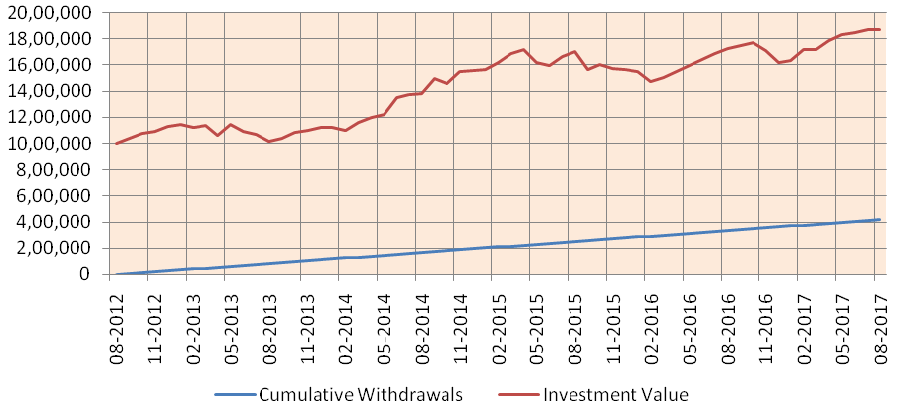
In stock market, we have both periods of both rising market and falling market. Let us see how SWP works over a sufficiently long period of time, covering both bull and bear markets. In the example below, we will see the results of a monthly SWP from SBI Bluechip Fund over the last 5 years. The last 5 years had both bull and bear markets. Let us assume you invested Rs 10 lakhs in SBI Bluechip Fund (Growth Option) on August 1, 2008.

Further, let us assume that your SWP amount is Rs 7,000 and that your withdrawal date is the 10th of every month. In Advisorkhoj,we urge you to use our calculator, if you are planning an SWP, to get a sense of historical SWP performance of different schemes. We will present the results of the SBI Bluechip Fund SWP example in a summary format; to see detailed results.


You can see that, despite making regular withdrawals (cumulative withdrawal of Rs 4.2 lakhs in the last 5 years), the current investment value (as on August 18, 2017) is over Rs 18.7 lakhs. The SWP return (XIRR) is over 20.6%.
How did we get such impressive results?

The impressive results can be attributed to two main factors. Firstly, the scheme performance was great over the last 5 years. The importance of selecting a good scheme, which gives consistently good returns, cannot be understated. Consistency of performance is extremely important when you are selecting funds for SWP because you will be making regular withdrawals in SWP. A scheme which underperforms for long periods of time can undermine your SWP; hence, the importance of consistent performance in SWP.


The second important factor was that, our withdrawal rate was not excessively high. Your withdrawal rate will be determined by your cash-flow needs, but if it is higher than the average rate of return on investment over a certain period, then you may end up with less than what you invested.

In fact, in our view, you should adopt a conservative approach to withdrawal, because capital markets can be unpredictable. If there is a market crash just when you are beginning your SWP, you will see your unit balance diminishing rapidly. When planning an SWP, it always prudent to be prepared for a bear market (where market can crash 20 – 30%). If the market crashes 30% and your withdrawal rate is 20% per annum, your investment value will be 50% of your initial investment amount; it can take a long time to recover from such a situation. On the other hand, if you withdrawal rate is lower, the recovery will be that much faster.
What should be the ideal withdrawal rate?

There are no hard and fast rules. There is one school of thought, which says that, you withdraw what you need. If your investment amount is large enough to ensure that your withdrawal rate is lower than the average return on investment, over a period of time, it is fine. There is another school of thought, which advocates a more conservative approach, allowing for the possibility of a bear market before your investment has a chance to grow in value.

There is a third school of thought, which recommends the withdrawal rate to be the same as or lower than long term fixed income returns (Government Bond average long term yields can be taken as a proxy for long term fixed income returns). We used the third approach, in the SBI Bluechip Fund SWP example, but we are not saying that, this is the ideal approach. Your withdrawal rate should be determined by how much you can invest, your cash-flow needs, and at same time, making sure that, the withdrawal rate is lower than the average rate of return over a period of time, allowing for the possibility of a bear market in the near future. It is a careful balancing act.
Be mindful of exit loads and capital gains tax considerations

SWP is essentially a series of redemptions, to meet your income needs. Mutual fund unit redemptions, within a certain period from the date of investment, may attract exit loads. Therefore, you should be consider exit load period when planning your SWP. You should also know that, capital gains tax will apply, when you are selling your mutual fund units within 12 months from the date of investment. Profits made from sale of units of equity funds within 12 months from the date of investment are taxed at 15% (short term capital gains tax). Profits made from sale of units of equity funds after 12 months from the date of investment are tax-free. You should plan your SWP accordingly.
Long term SWP from debt oriented funds can yield tax benefits compared to traditional products

Interest income from traditional fixed income products like bank FDs (term deposits) and post office savings schemes are taxed as per the income tax slab of the investor. Debt mutual fund dividends, though tax-free in hands of the investors, attract a dividend distribution tax of 28.84%, payable by the AMC, thereby reducing the actual dividend pay-out to investors. Long term capital gains tax from debt funds are taxed at 20% after allowing for indexation benefits.

SWPs over a long term from debt funds result in the incidence of long term capital gains tax after 3 years from the date of investment. SWPs are therefore, more tax efficient than traditional fixed income schemes or even dividend options of debt funds, over a long (more than 3 years) investment horizon.

SWP from balanced funds is also an ideal option as the taxation of balanced funds is same as that of equity funds

Conclusion

Mutual funds offer a variety of smart and convenient options to meet specific needs of investors. While awareness of mutual funds in India has been increasing steadily over the past decade, there is still lack of awareness of some smart investment facilities available to investors. Our endeavour is to enhance awareness of the smart facilities among the investor population. In this blog post, we discussed about various aspects of Systematic Withdrawal Plans. SWP is a smart and convenient option for getting predictable cash-flows from your investment; at the same time, there a multiple considerations that you need to be aware of, to get the desired results from your SWP. If you need regular income from your investments, you should discuss Systematic Withdrawal Plan options with your financial advisors..


Mutual Fund Investments are subject to market risk, read all scheme related documents carefully.

Smart option to get regular income from your investment

Monthly SWP from SBI Bluechip Fund over the last 5 years
  1. When investors want regular income from their investments the automatic choices for many are bank term deposits or post office monthly income scheme. However, declining interest rates have caused many investors to be worried about meeting their income needs from traditional savings schemes. Dividend is another source of income for some investors, but you should understand that dividends are distributed from the profit after tax of a company. If a company makes a loss, for any reason, it will not be able to pay dividends. Further, dividends are declared at the discretion of the management; so there is no assurance of the dividend amount for the shareholder. Most importantly, retail investors should remember that investing in shares of companies can be quite risky, unless you have sufficient experience and expertise in equity investing.
  2. Based on the investor queries received by Advisorkhoj.com and traffic analytics of different sections of our website, we have seen that lot of investors are now interested in mutual fund schemes which pay regular dividends. Mutual funds are less risky than stocks since company specific risks are diversified away in mutual funds and as such, they are better investment options for retail investors. Some mutual fund schemes have excellent dividend pay-out track records and as such, can be good investment options for investors seeking regular income.

However, it is important for mutual fund investors to know that, regulations decree dividends to be paid only from the accumulated profits of a scheme. Mutual funds are subject to market risks and their performance is linked to market conditions. If a mutual fund scheme is not able to make profits due to adverse market conditions it will not be able to pay dividends. Dividends are declared at the discretion of the fund manager of the scheme and there is no assurance with respect to amount or timing of the dividend.
Investors, who want to meet all or most of their income needs from their investments, require a fair bit of certainty with respect to cash-flows, both in terms of amount and timing. Systematic Withdrawal Plans is a smart investment option for such investors because it gives fixed cash-flows to investors. We are seeing lot of interest in Systematic Withdrawal Plans among retail investors; it shows growing maturity of Indian investors and willingness to explore non-traditional investment options.

What is Systematic Withdrawal Plan?

In Systematic Withdrawal Plan (SWP), you can draw a fixed amount from your mutual fund investment at a specified frequency (monthly, quarterly, annual etc.); you can specify the day of the month when the withdrawal should be made and the amount will be credited directly to your bank account on the specified day. You can continue your SWP as long as there are balance units in your mutual fund scheme account.
To know more about SWP.

How does Systematic Withdrawal Plan work?

Systematic Withdrawal Plan generates cash-flows (income) for investors by redeeming units of mutual fund scheme at specified intervals. The number of units redeemed to generate cash-flows in an SWP depends on the SWP amount and the scheme Net Asset Values (NAV) on the withdrawal dates. For example, let us assume you invested Rs 10 lakhs in a mutual fund scheme. The purchase NAV was Rs 20; so, 50,000 units will be allotted to you. Let us assume you start a monthly SWP of Rs 6,000 after one year from the date of investment to avoid exit loads. In the first month of the SWP, the scheme NAV is 25 (illustrative). In order to generate Rs 6,000 for you, the Asset Management Company (AMC) will redeem 240 units (Rs 6,000 divided by 25). Your balance units will be 49,760 (50,000 minus 240). In the second month, if the NAV is 27, the AMC will redeem 222.22 units ((Rs 6,000 divided by 25) for the SWP and your unit balance will be 49,537.78 (49,760 minus 222.22). In the third month if the scheme NAV is 28, the AMC will redeem 214.28 units and your unit balance will be 49,323.49.
In an SWP, your unit balance will diminish over time, but if the NAV keeps moving at a faster rate than your withdrawal rate, then your investment value will be higher. In the above example, after your third SWP instalment, your investment value will be Rs 13,81,058. You can see that, your investment value has gone up even after making monthly withdrawals. However, if the scheme NAV keeps falling instead of rising, like in a bear market, then effect on your investment value will be opposite, because withdrawals in a falling NAV scenario will require redemption of a higher number of units. Consequently, you will be left with a lower unit balance, which in an environment of falling NAVs can have an adverse impact on your investment.
You may like to know.

An actual SWP example

In stock market, we have both periods of both rising market and falling market. Let us see how SWP works over a sufficiently long period of time, covering both bull and bear markets. In the example below, we will see the results of a monthly SWP from SBI Bluechip Fund over the last 5 years. The last 5 years had both bull and bear markets. Let us assume you invested Rs 10 lakhs in SBI Bluechip Fund (Growth Option) on August 1, 2008.
Further, let us assume that your SWP amount is Rs 7,000 and that your withdrawal date is the 10th of every month. In Advisorkhoj,we urge you to use our calculator, if you are planning an SWP, to get a sense of historical SWP performance of different schemes. We will present the results of the SBI Bluechip Fund SWP example in a summary format; to see detailed results.

You can see that, despite making regular withdrawals (cumulative withdrawal of Rs 4.2 lakhs in the last 5 years), the current investment value (as on August 18, 2017) is over Rs 18.7 lakhs. The SWP return (XIRR) is over 20.6%.

How did we get such impressive results?

The impressive results can be attributed to two main factors. Firstly, the scheme performance was great over the last 5 years. The importance of selecting a good scheme, which gives consistently good returns, cannot be understated. Consistency of performance is extremely important when you are selecting funds for SWP because you will be making regular withdrawals in SWP. A scheme which underperforms for long periods of time can undermine your SWP; hence, the importance of consistent performance in SWP.

The second important factor was that, our withdrawal rate was not excessively high. Your withdrawal rate will be determined by your cash-flow needs, but if it is higher than the average rate of return on investment over a certain period, then you may end up with less than what you invested.
In fact, in our view, you should adopt a conservative approach to withdrawal, because capital markets can be unpredictable. If there is a market crash just when you are beginning your SWP, you will see your unit balance diminishing rapidly. When planning an SWP, it always prudent to be prepared for a bear market (where market can crash 20 – 30%). If the market crashes 30% and your withdrawal rate is 20% per annum, your investment value will be 50% of your initial investment amount; it can take a long time to recover from such a situation. On the other hand, if you withdrawal rate is lower, the recovery will be that much faster.

What should be the ideal withdrawal rate?

There are no hard and fast rules. There is one school of thought, which says that, you withdraw what you need. If your investment amount is large enough to ensure that your withdrawal rate is lower than the average return on investment, over a period of time, it is fine. There is another school of thought, which advocates a more conservative approach, allowing for the possibility of a bear market before your investment has a chance to grow in value.
There is a third school of thought, which recommends the withdrawal rate to be the same as or lower than long term fixed income returns (Government Bond average long term yields can be taken as a proxy for long term fixed income returns). We used the third approach, in the SBI Bluechip Fund SWP example, but we are not saying that, this is the ideal approach. Your withdrawal rate should be determined by how much you can invest, your cash-flow needs, and at same time, making sure that, the withdrawal rate is lower than the average rate of return over a period of time, allowing for the possibility of a bear market in the near future. It is a careful balancing act.

Be mindful of exit loads and capital gains tax considerations

SWP is essentially a series of redemptions, to meet your income needs. Mutual fund unit redemptions, within a certain period from the date of investment, may attract exit loads. Therefore, you should be consider exit load period when planning your SWP. You should also know that, capital gains tax will apply, when you are selling your mutual fund units within 12 months from the date of investment. Profits made from sale of units of equity funds within 12 months from the date of investment are taxed at 15% (short term capital gains tax). Profits made from sale of units of equity funds after 12 months from the date of investment are tax-free. You should plan your SWP accordingly.

Long term SWP from debt oriented funds can yield tax benefits compared to traditional products

Interest income from traditional fixed income products like bank FDs (term deposits) and post office savings schemes are taxed as per the income tax slab of the investor. Debt mutual fund dividends, though tax-free in hands of the investors, attract a dividend distribution tax of 28.84%, payable by the AMC, thereby reducing the actual dividend pay-out to investors. Long term capital gains tax from debt funds are taxed at 20% after allowing for indexation benefits.
SWPs over a long term from debt funds result in the incidence of long term capital gains tax after 3 years from the date of investment. SWPs are therefore, more tax efficient than traditional fixed income schemes or even dividend options of debt funds, over a long (more than 3 years) investment horizon.
SWP from balanced funds is also an ideal option as the taxation of balanced funds is same as that of equity funds
Conclusion
Mutual funds offer a variety of smart and convenient options to meet specific needs of investors. While awareness of mutual funds in India has been increasing steadily over the past decade, there is still lack of awareness of some smart investment facilities available to investors. Our endeavour is to enhance awareness of the smart facilities among the investor population. In this blog post, we discussed about various aspects of Systematic Withdrawal Plans. SWP is a smart and convenient option for getting predictable cash-flows from your investment; at the same time, there a multiple considerations that you need to be aware of, to get the desired results from your SWP. If you need regular income from your investments, you should discuss Systematic Withdrawal Plan options with your financial advisors.
.
Mutual Fund Investments are subject to market risk, read all scheme related documents carefully.

Smart option to get regular income from your investment

Monthly SWP from SBI Bluechip Fund over the last 5 years
  1. When investors want regular income from their investments the automatic choices for many are bank term deposits or post office monthly income scheme. However, declining interest rates have caused many investors to be worried about meeting their income needs from traditional savings schemes. Dividend is another source of income for some investors, but you should understand that dividends are distributed from the profit after tax of a company. If a company makes a loss, for any reason, it will not be able to pay dividends. Further, dividends are declared at the discretion of the management; so there is no assurance of the dividend amount for the shareholder. Most importantly, retail investors should remember that investing in shares of companies can be quite risky, unless you have sufficient experience and expertise in equity investing.
  2. Based on the investor queries received by Advisorkhoj.com and traffic analytics of different sections of our website, we have seen that lot of investors are now interested in mutual fund schemes which pay regular dividends. Mutual funds are less risky than stocks since company specific risks are diversified away in mutual funds and as such, they are better investment options for retail investors. Some mutual fund schemes have excellent dividend pay-out track records and as such, can be good investment options for investors seeking regular income.

However, it is important for mutual fund investors to know that, regulations decree dividends to be paid only from the accumulated profits of a scheme. Mutual funds are subject to market risks and their performance is linked to market conditions. If a mutual fund scheme is not able to make profits due to adverse market conditions it will not be able to pay dividends. Dividends are declared at the discretion of the fund manager of the scheme and there is no assurance with respect to amount or timing of the dividend.
Investors, who want to meet all or most of their income needs from their investments, require a fair bit of certainty with respect to cash-flows, both in terms of amount and timing. Systematic Withdrawal Plans is a smart investment option for such investors because it gives fixed cash-flows to investors. We are seeing lot of interest in Systematic Withdrawal Plans among retail investors; it shows growing maturity of Indian investors and willingness to explore non-traditional investment options.

What is Systematic Withdrawal Plan?

In Systematic Withdrawal Plan (SWP), you can draw a fixed amount from your mutual fund investment at a specified frequency (monthly, quarterly, annual etc.); you can specify the day of the month when the withdrawal should be made and the amount will be credited directly to your bank account on the specified day. You can continue your SWP as long as there are balance units in your mutual fund scheme account.
To know more about SWP.

How does Systematic Withdrawal Plan work?

Systematic Withdrawal Plan generates cash-flows (income) for investors by redeeming units of mutual fund scheme at specified intervals. The number of units redeemed to generate cash-flows in an SWP depends on the SWP amount and the scheme Net Asset Values (NAV) on the withdrawal dates. For example, let us assume you invested Rs 10 lakhs in a mutual fund scheme. The purchase NAV was Rs 20; so, 50,000 units will be allotted to you. Let us assume you start a monthly SWP of Rs 6,000 after one year from the date of investment to avoid exit loads. In the first month of the SWP, the scheme NAV is 25 (illustrative). In order to generate Rs 6,000 for you, the Asset Management Company (AMC) will redeem 240 units (Rs 6,000 divided by 25). Your balance units will be 49,760 (50,000 minus 240). In the second month, if the NAV is 27, the AMC will redeem 222.22 units ((Rs 6,000 divided by 25) for the SWP and your unit balance will be 49,537.78 (49,760 minus 222.22). In the third month if the scheme NAV is 28, the AMC will redeem 214.28 units and your unit balance will be 49,323.49.
In an SWP, your unit balance will diminish over time, but if the NAV keeps moving at a faster rate than your withdrawal rate, then your investment value will be higher. In the above example, after your third SWP instalment, your investment value will be Rs 13,81,058. You can see that, your investment value has gone up even after making monthly withdrawals. However, if the scheme NAV keeps falling instead of rising, like in a bear market, then effect on your investment value will be opposite, because withdrawals in a falling NAV scenario will require redemption of a higher number of units. Consequently, you will be left with a lower unit balance, which in an environment of falling NAVs can have an adverse impact on your investment.
You may like to know.

An actual SWP example

In stock market, we have both periods of both rising market and falling market. Let us see how SWP works over a sufficiently long period of time, covering both bull and bear markets. In the example below, we will see the results of a monthly SWP from SBI Bluechip Fund over the last 5 years. The last 5 years had both bull and bear markets. Let us assume you invested Rs 10 lakhs in SBI Bluechip Fund (Growth Option) on August 1, 2008.
Further, let us assume that your SWP amount is Rs 7,000 and that your withdrawal date is the 10th of every month. In Advisorkhoj,we urge you to use our calculator, if you are planning an SWP, to get a sense of historical SWP performance of different schemes. We will present the results of the SBI Bluechip Fund SWP example in a summary format; to see detailed results.

You can see that, despite making regular withdrawals (cumulative withdrawal of Rs 4.2 lakhs in the last 5 years), the current investment value (as on August 18, 2017) is over Rs 18.7 lakhs. The SWP return (XIRR) is over 20.6%.

How did we get such impressive results?

The impressive results can be attributed to two main factors. Firstly, the scheme performance was great over the last 5 years. The importance of selecting a good scheme, which gives consistently good returns, cannot be understated. Consistency of performance is extremely important when you are selecting funds for SWP because you will be making regular withdrawals in SWP. A scheme which underperforms for long periods of time can undermine your SWP; hence, the importance of consistent performance in SWP.

The second important factor was that, our withdrawal rate was not excessively high. Your withdrawal rate will be determined by your cash-flow needs, but if it is higher than the average rate of return on investment over a certain period, then you may end up with less than what you invested.
In fact, in our view, you should adopt a conservative approach to withdrawal, because capital markets can be unpredictable. If there is a market crash just when you are beginning your SWP, you will see your unit balance diminishing rapidly. When planning an SWP, it always prudent to be prepared for a bear market (where market can crash 20 – 30%). If the market crashes 30% and your withdrawal rate is 20% per annum, your investment value will be 50% of your initial investment amount; it can take a long time to recover from such a situation. On the other hand, if you withdrawal rate is lower, the recovery will be that much faster.

What should be the ideal withdrawal rate?

There are no hard and fast rules. There is one school of thought, which says that, you withdraw what you need. If your investment amount is large enough to ensure that your withdrawal rate is lower than the average return on investment, over a period of time, it is fine. There is another school of thought, which advocates a more conservative approach, allowing for the possibility of a bear market before your investment has a chance to grow in value.
There is a third school of thought, which recommends the withdrawal rate to be the same as or lower than long term fixed income returns (Government Bond average long term yields can be taken as a proxy for long term fixed income returns). We used the third approach, in the SBI Bluechip Fund SWP example, but we are not saying that, this is the ideal approach. Your withdrawal rate should be determined by how much you can invest, your cash-flow needs, and at same time, making sure that, the withdrawal rate is lower than the average rate of return over a period of time, allowing for the possibility of a bear market in the near future. It is a careful balancing act.

Be mindful of exit loads and capital gains tax considerations

SWP is essentially a series of redemptions, to meet your income needs. Mutual fund unit redemptions, within a certain period from the date of investment, may attract exit loads. Therefore, you should be consider exit load period when planning your SWP. You should also know that, capital gains tax will apply, when you are selling your mutual fund units within 12 months from the date of investment. Profits made from sale of units of equity funds within 12 months from the date of investment are taxed at 15% (short term capital gains tax). Profits made from sale of units of equity funds after 12 months from the date of investment are tax-free. You should plan your SWP accordingly.

Long term SWP from debt oriented funds can yield tax benefits compared to traditional products

Interest income from traditional fixed income products like bank FDs (term deposits) and post office savings schemes are taxed as per the income tax slab of the investor. Debt mutual fund dividends, though tax-free in hands of the investors, attract a dividend distribution tax of 28.84%, payable by the AMC, thereby reducing the actual dividend pay-out to investors. Long term capital gains tax from debt funds are taxed at 20% after allowing for indexation benefits.
SWPs over a long term from debt funds result in the incidence of long term capital gains tax after 3 years from the date of investment. SWPs are therefore, more tax efficient than traditional fixed income schemes or even dividend options of debt funds, over a long (more than 3 years) investment horizon.
SWP from balanced funds is also an ideal option as the taxation of balanced funds is same as that of equity funds. Know why Why Balanced Funds may be the best investments for new mutual fund investors
You may also like to read about a balanced fund which is one of the Best Balanced Fund in the last 5 years
Conclusion
Mutual funds offer a variety of smart and convenient options to meet specific needs of investors. While awareness of mutual funds in India has been increasing steadily over the past decade, there is still lack of awareness of some smart investment facilities available to investors. Our endeavour is to enhance awareness of the smart facilities among the investor population. In this blog post, we discussed about various aspects of Systematic Withdrawal Plans. SWP is a smart and convenient option for getting predictable cash-flows from your investment; at the same time, there a multiple considerations that you need to be aware of, to get the desired results from your SWP. If you need regular income from your investments, you should discuss Systematic Withdrawal Plan options with your financial advisors.
.
Mutual Fund Investments are subject to market risk, read all scheme related documents carefully.

Systematic Withdrawal Plan: Smart option to get regular income from your investment

Monthly SWP from SBI Bluechip Fund over the last 5 years
When investors want regular income from their investments the automatic choices for many are bank term deposits or post office monthly income scheme. However, declining interest rates have caused many investors to be worried about meeting their income needs from traditional savings schemes. Dividend is another source of income for some investors, but you should understand that dividends are distributed from the profit after tax of a company. If a company makes a loss, for any reason, it will not be able to pay dividends. Further, dividends are declared at the discretion of the management; so there is no assurance of the dividend amount for the shareholder. Most importantly, retail investors should remember that investing in shares of companies can be quite risky, unless you have sufficient experience and expertise in equity investing.
Based on the investor queries received by Advisorkhoj.com and traffic analytics of different sections of our website, we have seen that lot of investors are now interested in mutual fund schemes which pay regular dividends. Mutual funds are less risky than stocks since company specific risks are diversified away in mutual funds and as such, they are better investment options for retail investors. Some mutual fund schemes have excellent dividend pay-out track records and as such, can be good investment options for investors seeking regular income.

However, it is important for mutual fund investors to know that, regulations decree dividends to be paid only from the accumulated profits of a scheme. Mutual funds are subject to market risks and their performance is linked to market conditions. If a mutual fund scheme is not able to make profits due to adverse market conditions it will not be able to pay dividends. Dividends are declared at the discretion of the fund manager of the scheme and there is no assurance with respect to amount or timing of the dividend.
Investors, who want to meet all or most of their income needs from their investments, require a fair bit of certainty with respect to cash-flows, both in terms of amount and timing. Systematic Withdrawal Plans is a smart investment option for such investors because it gives fixed cash-flows to investors. We are seeing lot of interest in Systematic Withdrawal Plans among retail investors; it shows growing maturity of Indian investors and willingness to explore non-traditional investment options.

What is Systematic Withdrawal Plan?

In Systematic Withdrawal Plan (SWP), you can draw a fixed amount from your mutual fund investment at a specified frequency (monthly, quarterly, annual etc.); you can specify the day of the month when the withdrawal should be made and the amount will be credited directly to your bank account on the specified day. You can continue your SWP as long as there are balance units in your mutual fund scheme account.
To know more about SWP.

How does Systematic Withdrawal Plan work?

Systematic Withdrawal Plan generates cash-flows (income) for investors by redeeming units of mutual fund scheme at specified intervals. The number of units redeemed to generate cash-flows in an SWP depends on the SWP amount and the scheme Net Asset Values (NAV) on the withdrawal dates. For example, let us assume you invested Rs 10 lakhs in a mutual fund scheme. The purchase NAV was Rs 20; so, 50,000 units will be allotted to you. Let us assume you start a monthly SWP of Rs 6,000 after one year from the date of investment to avoid exit loads. In the first month of the SWP, the scheme NAV is 25 (illustrative). In order to generate Rs 6,000 for you, the Asset Management Company (AMC) will redeem 240 units (Rs 6,000 divided by 25). Your balance units will be 49,760 (50,000 minus 240). In the second month, if the NAV is 27, the AMC will redeem 222.22 units ((Rs 6,000 divided by 25) for the SWP and your unit balance will be 49,537.78 (49,760 minus 222.22). In the third month if the scheme NAV is 28, the AMC will redeem 214.28 units and your unit balance will be 49,323.49.
In an SWP, your unit balance will diminish over time, but if the NAV keeps moving at a faster rate than your withdrawal rate, then your investment value will be higher. In the above example, after your third SWP instalment, your investment value will be Rs 13,81,058. You can see that, your investment value has gone up even after making monthly withdrawals. However, if the scheme NAV keeps falling instead of rising, like in a bear market, then effect on your investment value will be opposite, because withdrawals in a falling NAV scenario will require redemption of a higher number of units. Consequently, you will be left with a lower unit balance, which in an environment of falling NAVs can have an adverse impact on your investment.
You may like to know.

An actual SWP example

In stock market, we have both periods of both rising market and falling market. Let us see how SWP works over a sufficiently long period of time, covering both bull and bear markets. In the example below, we will see the results of a monthly SWP from SBI Bluechip Fund over the last 5 years. The last 5 years had both bull and bear markets. Let us assume you invested Rs 10 lakhs in SBI Bluechip Fund (Growth Option) on August 1, 2008.
Further, let us assume that your SWP amount is Rs 7,000 and that your withdrawal date is the 10th of every month. In Advisorkhoj, we have developed an SWP calculator; we urge you to use our calculator, if you are planning an SWP, to get a sense of historical SWP performance of different schemes. We will present the results of the SBI Bluechip Fund SWP example in a summary format; to see detailed results.

You can see that, despite making regular withdrawals (cumulative withdrawal of Rs 4.2 lakhs in the last 5 years), the current investment value (as on August 18, 2017) is over Rs 18.7 lakhs. The SWP return (XIRR) is over 20.6%.

How did we get such impressive results?

The impressive results can be attributed to two main factors. Firstly, the scheme performance was great over the last 5 years. The importance of selecting a good scheme, which gives consistently good returns, cannot be understated. Consistency of performance is extremely important when you are selecting funds for SWP because you will be making regular withdrawals in SWP. A scheme which underperforms for long periods of time can undermine your SWP; hence, the importance of consistent performance in SWP.
The second important factor was that, our withdrawal rate was not excessively high. Your withdrawal rate will be determined by your cash-flow needs, but if it is higher than the average rate of return on investment over a certain period, then you may end up with less than what you invested.
In fact, in our view, you should adopt a conservative approach to withdrawal, because capital markets can be unpredictable. If there is a market crash just when you are beginning your SWP, you will see your unit balance diminishing rapidly. When planning an SWP, it always prudent to be prepared for a bear market (where market can crash 20 – 30%). If the market crashes 30% and your withdrawal rate is 20% per annum, your investment value will be 50% of your initial investment amount; it can take a long time to recover from such a situation. On the other hand, if you withdrawal rate is lower, the recovery will be that much faster.

What should be the ideal withdrawal rate?

There are no hard and fast rules. There is one school of thought, which says that, you withdraw what you need. If your investment amount is large enough to ensure that your withdrawal rate is lower than the average return on investment, over a period of time, it is fine. There is another school of thought, which advocates a more conservative approach, allowing for the possibility of a bear market before your investment has a chance to grow in value.
There is a third school of thought, which recommends the withdrawal rate to be the same as or lower than long term fixed income returns (Government Bond average long term yields can be taken as a proxy for long term fixed income returns). We used the third approach, in the SBI Bluechip Fund SWP example, but we are not saying that, this is the ideal approach. Your withdrawal rate should be determined by how much you can invest, your cash-flow needs, and at same time, making sure that, the withdrawal rate is lower than the average rate of return over a period of time, allowing for the possibility of a bear market in the near future. It is a careful balancing act.

Be mindful of exit loads and capital gains tax considerations

SWP is essentially a series of redemptions, to meet your income needs. Mutual fund unit redemptions, within a certain period from the date of investment, may attract exit loads. Therefore, you should be consider exit load period when planning your SWP. You should also know that, capital gains tax will apply, when you are selling your mutual fund units within 12 months from the date of investment. Profits made from sale of units of equity funds within 12 months from the date of investment are taxed at 15% (short term capital gains tax). Profits made from sale of units of equity funds after 12 months from the date of investment are tax-free. You should plan your SWP accordingly.

Long term SWP from debt oriented funds can yield tax benefits compared to traditional products

Interest income from traditional fixed income products like bank FDs (term deposits) and post office savings schemes are taxed as per the income tax slab of the investor. Debt mutual fund dividends, though tax-free in hands of the investors, attract a dividend distribution tax of 28.84%, payable by the AMC, thereby reducing the actual dividend pay-out to investors. Long term capital gains tax from debt funds are taxed at 20% after allowing for indexation benefits.
SWPs over a long term from debt funds result in the incidence of long term capital gains tax after 3 years from the date of investment. SWPs are therefore, more tax efficient than traditional fixed income schemes or even dividend options of debt funds, over a long (more than 3 years) investment horizon.
SWP from balanced funds is also an ideal option as the taxation of balanced funds is same as that of equity funds. Know why Why Balanced Funds may be the best investments for new mutual fund investors
You may also like to read about a balanced fund which is one of the Best Balanced Fund in the last 5 years
Conclusion
Mutual funds offer a variety of smart and convenient options to meet specific needs of investors. While awareness of mutual funds in India has been increasing steadily over the past decade, there is still lack of awareness of some smart investment facilities available to investors. Our endeavour is to enhance awareness of the smart facilities among the investor population. In this blog post, we discussed about various aspects of Systematic Withdrawal Plans. SWP is a smart and convenient option for getting predictable cash-flows from your investment; at the same time, there a multiple considerations that you need to be aware of, to get the desired results from your SWP. If you need regular income from your investments, you should discuss Systematic Withdrawal Plan options with your financial advisors.
.
Mutual Fund Investments are subject to market risk, read all scheme related documents carefully.

BAJAJ HOLDINGS & INVESTMENTS / Non-Banking Financial Company

MUTUAL FUNDS VS FIXED DEPOSIT

Bajaj Finance Fixed Deposit Features & Benefits | Up to 8.10% Returns

Fixed Deposit (FD): Features and Benefits:

an interest rate of 7.85 %, Bajaj Finance’s Fixed Deposit offers one of the safest investment at one of the best interest rates in the country.
Bajaj Finance Offers the Following FD Schemes:
Customer Categories Interest Rates
If you are new FD customer 7.85%
If you are a senior citizen 8.10%
If you are our loan customer 7.95%
If you are a Bajaj group employee 7.95%
If you renew your FD +0.10%

Features of Bajaj Finance’s Fixed Deposit (FD):

  1. 7.85% return on your investment
    Bajaj Finance offers 7.85% interest rate on FDs, which is one of the highest in the market. The interest rate can go up to 8.10% depending on the customer type. This makes Fixed Deposit investment more lucrative option than keeping your money in a savings bank account.

  2. High on stability and credibility
    Bajaj Finance’s FD has one of the highest approval ratings in the market, which means safety and reliability for every investor. Bajaj Finance’s FD has been awarded with ICRA’s MAAA (Stable) Rating and CRISIL’s FAAA/Stable Rating.

  3. Online application process
    To open an FD with Bajaj Finance, you can easily apply online through our website. Once you fill in the application form, an agent will call you to collect the documents and payment cheque.

  4. Minimum deposit of Rs.25,000
    Fixed Deposit gives you steady returns with high interest rates. You can start your FD with Bajaj Finance with a minimum deposit of Rs.25,000. However, the bigger the investment, higher the returns.

  5. Fixed Deposit Calculator available
    Use our Fixed Deposit Calculator to calculate the interest and determine the maturity amount of the deposit you can make. This also helps you calculate and compare the interest receivable by changing the deposit amount, tenor and interest payment frequency.

  6. 200+ branches all over the country
    We have a huge network of people to help you open a Fixed Deposit account. We provide the Deposit facility in 200+ cities in India. This means that you can easily access any of our branch to open your FD. Here’s a list of all the cities where we offer the Fixed Deposits facility.

  7. Manage your FD online
    Manage your FD account online by seeing all the interest transfers and other information. Just log in to your fixed deposit account via Bajaj Finance’s customer portal, Experia and manage your account online.

  8. Flexible FD Tenure between 12-60 Month:
    With Bajaj Finance’s Fixed Deposit, you have the flexibility to choose your tenure from 12 to 60 months according to your needs. If you change your mind, you have the flexibility to close your FD account and start another one for a different duration.

Benefits of Investing in a Fixed Deposit:

Why settle for a 4% interest rate in your savings account when you can earn as high as 7.85% in a Fixed Deposit with Bajaj Finance? Here are some of the benefits of investing in a fixed deposit:
  1. No volatility:
    When interest rates drop and rise, changing rapidly, investors look for safety, and this is when fixed deposits offer the right investment opportunity..

  2. Not dependent on market fluctuations:
    A fixed deposit remains stable and risk-free no matter whether the market is fluctuating or if the economy is experiencing a flux due to inflation or any other reason.

  3. A necessary part of your portfolio as a prudent investor:
    Generations of Indian families have considered fixed deposits for safekeeping and growing their life’s savings. Not only is your principal amount invested free of any risk fluctuations, but the yield over time is also a promising amount.

  4. Higher interest rates for senior citizens:
    Senior citizens can benefit greatly from investing their life’s savings in an FD as they are eligible for an additional rate of interest—as high as 0.25% more than the average.

Fixed Deposits: Your Gateway To A Safe Present and A Secure Future

Fixed deposits have a long history of being one of the safest investment options available to Indian investors. They are considered to be a necessary part of any prudent investor’s financial portfolio. In the case of fixed deposit investments, it is important to note that you do not have to spend money to make money. In fact, with proper planning and the right financing corporation, you can go on saving money by reinvesting the money you saved in the first place. All it takes is a smart investment plan which offers a high interest rate, flexible tenors and easy functionality.

The advantages of fixed deposits begin with instantaneous online application approval and carry on all the way to the end with highest rates of return on the longest tenors. There are companies where customer satisfaction is accorded with the highest priority through hundreds of fixed deposit-dedicated branches across the country, completely online management of your account, and an accurate calculator that determines exactly how much you earn after your fixed deposit matures.

Financial Safety at Its Best

Most investors know the regular benefits of FD like higher rates of return and better liquidity options, but here’s a list of what makes a fixed deposit one of your safest preferences:

Guaranteed Return on Investment

Fixed deposits come with a fool-proof offer of receiving your funds back, with interest. No matter what the market condition is, you can always trust fixed deposits to come through for you.

Fixed Rate of Interest

From the moment you apply for fixed deposits until the maturity of your tenor, the interest rate on fixed deposits is never subject to any change. Even if the rates for other investments experience a downfall, your rate of return will not be affected at all.

Flexible Tenor

If you’re planning on saving money, it’s important to know what the future holds. That is the only way most investments pay out profitable returns. With fixed deposits, however, you do not have to worry even if your future in uncertain because they offer a highly flexible tenor period—from 12 months to 60 months.

Tax Savings

Under section 80C of the Income Tax Act formulated in 1961, fixed deposits up to 1 lakh are eligible for tax deductions if the maturity period is 5 years, but the interest earned is taxable.

Safety Net

If, due to unforeseen circumstances, you require a loan from any financial corporation, fixed deposits provide an easy option by letting you take a loan on FD. This means that the company will give you up to 70% to 90% credit as a loan on your own fixed deposit.

Cumulative or Non-cumulative Fixed Deposits

In the interest of financial safety and to keep a constant tab on your funds, some companies offer the option to choose between cumulative and non-cumulative fixed deposits. Although the rates of interest are slightly lower on non-cumulative fixed deposit, you can check through online fixed deposit calculator how rate of interest vary in cumulative and non cumulative fixed deposit. You have the advantage of obtaining a steady flow of cash throughout the tenor period.

Get Started On A Better CIBIL Score

Not only can you keep earning money on your fixed deposits even if you take out a loan on them, you can also improve your CIBIL score using the same loan since financing corporations need to have your credit information recorded with CIBIL to provide loans at a low cost.