Top Business News- News18.com

Tuesday, October 1, 2019

BALANCED FUNDS

WHAT IS A 'BALANCED FUND'

A balanced fund combines equity stock component, a bond component and sometimes a money market component in a single portfolio. Generally, these hybrid funds stick to a relatively fixed mix of stocks and bonds that reflects either a moderate, or higher equity, component, or conservative, or higher fixed-income, component orientation

These funds invest in a mix of equities and debt, giving the investor the best of both worlds. Balanced funds gain from a healthy dose of equities but the debt portion fortifies them against any downturn.

Balanced funds are suitable for a medium-term horizon and are ideal for investors who are looking for a mixture of safety, income and modest capital appreciation. The amounts this type of mutual fund invests into each asset class usually must remain within a set minimum and maximum.

Although they are in the "asset allocation" family, balanced fund portfolios do not materially change their asset mix. This is unlike life-cycle, target-date and actively managed asset-allocation funds, which make changes in response to an investor's changing risk-return appetite and age or overall investment market conditions.

EQUITIES AND INFLATION
Investors who have dual investment objectives favour Balanced Funds. Typically, retirees or investors with low risk tolerance prefer these funds for growth that outpaces inflation and income that supplements current needs. While retirees generally scale back risk as age advances, many individuals recognize the need for equity exposure as life expectancies increase. Equities prevent erosion of purchasing power and help ensure long-term preservation of retirement corpus

INCOME NEEDS
The bond component of a balanced fund serves two purposes: creating an income stream and moderating portfolio volatility. Investment-grade bonds such as AAA corporate bonds and Money market instruments interest income from periodic payments, while large-company stocks offer dividend payouts to enhance yield. Retired investors may take distributions in cash to bolster income from pensions and personal savings.

Secondarily, bonds hold much less volatility than stocks. Bondholders have a claim against assets of a company while stocks represent ownership, bearing all inherent risk if bankruptcy occurs. Hence, debt security prices do not move in lockstep with equities, and their stability prevents wild swings in the share price of a balanced fund.

TAXATION
Equity-oriented Balanced funds have a larger portion of their corpus (at least 65%) invested in stocks and qualify for the same tax treatment as equity funds. This means any capital gains are tax-free, if the investment is held for more than one year. However, these funds are more volatile due to the higher allocation to stocks.

Debt-oriented balanced funds are less volatile and suit those with a lower risk appetite. However, they offer lower returns and the gains are not eligible for tax exemption. If the investment is held for less than three years, the capital gains are treated as short term and taxed at the normal rates. But if the holding period exceeds three years, the gains are considered as long term and are taxed at 20% after indexation benefit, which can significantly reduce the tax.

LIQUID FUNDS

Liquid Funds, as the name suggests, invest predominantly in highly liquid money market instruments and debt securities of very short tenure and hence provide high liquidity. They invest in very short-term instruments such as Treasury Bills (T-bills), Commercial Paper (CP), Certificates Of Deposit (CD) and Collateralized Lending & Borrowing Obligations (CBLO) that have residual maturities of up to 91 days to generate optimal returns while maintaining safety and high liquidity. Redemption requests in these Liquid funds are processed within one working (T+1) day.

The aim of the fund manager of a Liquid Fund is to invest only into liquid investments with good credit rating with very low possibility of a default. The returns typically take the back seat as protection of capital remains of utmost importance. Control over expenses in the form of low expense ratio, good overall credit quality of the portfolio and a disciplined approach to investing are some of the key ingredients of a good liquid fund.

Most retail customers prefer to keep their surplus cash in Savings Bank deposits as they consider the same to be safest and they could withdraw the money at any time. Liquid Funds and Money Market Mutual Funds provide a more attractive option. Surplus cash invested in money market mutual funds earns higher post-tax returns with a reasonable degree of safety of the principal invested and liquidity.

Liquid funds are preferred by investors to park their money for short periods of time typically 1 day to 3 months. Wealth managers suggest liquid funds as an ideal parking ground when you have a sudden influx of cash, which could be a huge bonus, sale of real estate and so on and you are undecided about where to deploy that money. Investors looking out for opportunities in equities and long-term fixed income instruments can also park their money in the liquid funds in the meantime. Many equity investors use liquid funds to stagger their investments into equity mutual funds using the Systematic Transfer Plan (STP), as they believe this method could yield higher returns.

Liquid Funds typically do not charge any exit loads. Investors are offered growth and dividend options. Within dividend option, investors can choose daily, weekly or monthly dividends depending on their investment horizon and investment amount. Redemption payment is typically made within one working day of placing the redemption request. With mutual funds going online, individual investors with small sums can look at Liquid funds as an effective short-term investment option over their savings bank account.

DEBT FUNDS

IF YOU WANT TO AVOID THE MARKET FLUCTUATIONS OF EQUITY STOCKS AND ARE RISK-AVERSE, CONSIDER INVESTING IN DEBT-ORIENTED MUTUAL FUND SCHEMES.

WHAT IS DEBT FUND?
A debt fund is a mutual fund scheme that invests in fixed income instruments, such as Corporate and Government Bonds, corporate debt securities, and money market instruments etc. that offer capital appreciation. Debt funds are also referred to as Income Funds or Bond Funds.

WHO SHOULD INVEST IN A DEBT FUND?
Debt funds are ideal for investors who want regular income, but are risk-averse. Debt funds are less volatile and, hence, are less risky than equity funds. If you have been saving in traditional fixed income products like Term Deposits, and looking for steady returns with low volatility, debt mutual funds could be a better option, as they help you achieve your financial goals in a more tax efficient manner and therefore earn better returns.

HOW DEBT FUNDS WORK?
Debt funds invest in either listed or unlisted debt instruments, such as Corporate and Government Bonds at a certain price and later sell them at a margin. The difference between the cost and sale price accounts for the appreciation or depreciation in the fund’s net asset value (NAV). Debt funds also receive periodic interest from the underlying debt instruments in which they invest. In terms of return, debt funds that earn regular interest from the fixed income instruments during the fund’s tenure are similar to bank fixed deposits that earn interest. This interest income gets added to a debt fund on a daily basis. If the interest payment is received, say, once every year, it is divided by 365 and the debt fund’s NAV goes up daily by this small amount. Thus, a debt scheme’s NAV also depends on the interest rates of its underlying assets and also on any upgrade or downgrade in the credit rating of its holdings.

Market prices of debt securities change with movements in interest rates. Let’s assume, your debt fund owns a security that yields 10 % interest. If the interest rate in the economy falls, new instruments issued in the market would offer this lower rate. To match this lower rate, there would be an increase in the prices your fund’s underlying instruments as they have a higher coupon (interest) rate. As a result of the increase in the debt instrument’s value, your fund’s NAV, too, would increase.

HOW DEBT FUNDS ARE DIFFERENT FROM OTHER MUTUAL FUND SCHEMES?
In terms of operation, debt funds are not entirely different from other mutual fund schemes. However, in terms of safety, they score higher than equity mutual funds. For instance, when the market falls, the NAVs of your equity funds fall sharply, whereas in case of debt funds, the fall is not as sharp. Having said that, debt funds can offer only moderate returns, while equity funds, which are highly risky, offer high returns over longer time horizon.

WHY INVEST IN DEBT MUTUAL FUNDS?
A few major advantages of investing in debt funds are low cost structure, stable returns, high liquidity and reasonablesafety. Debt funds also score on post-tax return. Dividends from debt funds are exempt from tax in the hands of investors.The mutual fund, however, has to pay a Dividend Distribution Tax, which is currently 28.325 per cent in case of individuals or Hindu undivided families. While long-term capital gains from debt funds are taxed at 10 per cent without indexation and 20 per cent with indexation, short-term capital gains taxes are levied according to the income-tax bracket one belongs to.

Thus, debt funds can be a good alternative to investors for achieving their financial goals if they do not intend to bear risk involved in equity investments.

Growth Option vs. Dividend Option
As mentioned above, dividend from mutual funds is tax free in the hands of the investors, but the same is subject to Dividend Distribution Tax (currently 28.325 %), which indirectly decreases the net returns. Hence, dividend payment or dividend reinvestment option gives better post-tax returns, to those who are in the highest tax bracket. However, for those in lower tax slabs, growth option could be more tax-efficient. In short, one should choose the appropriate option depending on the tax bracket.

WHO SHOULD INVEST IN DEBT MUTUAL FUNDS?
There’s no fixed rule as to who should invest in debt funds. It depends on the requirement of investors. Different types of investors invest in different types of debt funds. For instance, if someone wants to park his emergency funds, he can go for liquid funds.
As a thumb rule, 3-6 month’s household expenses can be one’s emergency fund depending on the age. Roughly the amount that gives you the confidence to combat emergencies in your household should be enough. Anything more can actually affect your investment portfolio. Those in their 20s and 30s might need more, so garner funds for about six months’ expenses, whereas those nearing retirement might not need much as they would have built up their reserves. The amount you save for an emergency depends ultimately on what makes you comfortable.
If you are the risk-averse type, then you might prefer a large fund of, say, a year’s salary. If, however, you are the living on-the-edge type, then six months’ salary might suffice.

For those planning to buy a home after 2-3 years, investing in a combination of both long- and short-term debt funds might be a good idea. Also, a debt fund can be used in the overall portfolio for diversification across asset classes. Debt Funds can also be used for portfolio de-risking when you are nearing your financial goals.

HOW TO PICK THE RIGHT DEBT FUND?
Remember, it is the asset allocation (government securities, corporate debt and marketable securities) that largely determines how a debt fund’s NAV will move. A close look at a fund’s portfolio composition will give you an idea of the expected returns, risks and liquidity. So, when picking a fund, watch out for a few things.

One, check the average maturity of the fund’s portfolio as this has a bearing on your returns. The lower the average maturity period, the lower the fund’s volatility and your returns. On the other hand, a fund with a long maturity period is likely to be more volatile, but the returns are likely to be better.

Two, make sure the fund’s portfolio is reasonably liquid. A large percentage of corporate debt in the portfolio does not bode well in the short term, as it is relatively less liquid. If the fund faces redemption pressure, it would be forced to sell these securities at a discount, lowering the NAV. Also, be wary of funds that hold a lot of unrated and unlisted debt.

Three, avoid schemes with small corpuses. That’s because funds don’t disclose if there are any investor who owns a substantial chunk of outstanding units. If there are such investors and they decide to redeem their holdings, the fund could be forced to sell holdings below the market rates.

Four, the best tool to capture the interest rate sensitivity of a debt fund is modified duration. It tells you how much the price of a bond would move if interest rates move up or down by 1 per cent. The higher the modified duration, the greater will be the impact of an interest rate change. Mutual funds give you access to all the information in their offer documents and other periodic disclosures for you to make an informed decision. It is then up to you to take the investment decision and sign the form, or channel the money to suit your financial needs.

Also, you should understand how interest rate movements, credit ratings and liquidity affect a debt fund’s performance. Theoretically, if interest rates rise, the NAV of a debt fund should fall. That’s because Bond prices move in the opposite direction as interest rates. A fall in bond prices leads to a decline in a fund’s NAV. The opposite would happen if interest rates fell. Of course, in an imperfect and illiquid market like India, this might not happen to the entire extent. Moreover, if some bonds held by your debt fund are upgraded, their prices would rise, leading to a drop in yields. That would, of course, increase your fund’s NAV. So, one should be prepared for fluctuations in one’s fund’s NAV. Even Gilt Funds (which invest only in government securities) that are advertised as the safest available investments, can witness sharp fluctuations in their NAVs. That’s because prices of government securities are a function of various economic factors, including interest rates, macroeconomic data and liquidity in the banking system. When these change, so do the Gilt Fund’s NAV.

WHAT IS AVERAGE MATURITY AND HOW IS IT USEFUL?
Debt funds invest in a number of debt instruments, all of them having a varying maturity. That’s where the average maturity comes handy. As the name suggests, it basically indicates the average maturity of all the securities in a portfolio, giving you the freedom to compare.
Average maturity thus gives you a quick glimpse into the sensitivity of the bond to interest rates. Funds with higher average maturities tend to be more volatile in the short term since their objective is to deliver higher returns over the long term. Simply put, a fund with an average maturity of 5 years is definitely more volatile in the short term than a fund with an average maturity of say 9 months. That’s because in the shorter term there is reasonable surety on the receipt of the coupon income.

So matching your investment horizon with the average maturity is always a good idea. But remember, an average maturity of say 4 years doesn’t necessarily mean that you have to hold it for 4 years. But it definitely indicates is that you can expect to get optimal returns, given the interest rate environment, over 4 years.

Exit load isan effective mechanism that prompts investors to stay invested through the desired holding period. This ensures that investors, who move in and out of the fund and take away accrued gains during momentary positive market movements, do not short-change diligent investors who stay invested for the entire course.

WHY IS IT ESSENTIAL TO MATCH THE INVESTMENT HORIZON WITH THAT OF THE SCHEME?
Funds having a lower average maturity are ideal for short-term holdings as they are well protected from the fluctuating interest rate movements. However, holding them for more than their average maturity may not get you the optimal results.There can be various types of debt funds based on the average maturity of the instruments invested in. Although debt funds are less risky than equity funds, they are still subject to market volatility.The level of volatility therefore depends on the average maturity of the specific portfolio.

The higher the average maturity, the greater the uncertainty in the short term, which is what results in greater volatility. Conversely, the lower the average maturity, the greater the certainty, which in turn lowers volatility.

Liquid funds are the least volatile as their maturity is in days and at the other extreme there are income funds, where the average maturity is in multiple of years.

So in order to really get the most out of debt funds, it is essential that you match your investment horizon with the average maturity of the scheme.

USING DEBT FUNDS FOR STP AND SWP
Debt funds also allow you to take advantage of investing in equity market along with growth on your principal amount through Systematic Transfer Plan (STP). With an STP, you can transfer amounts in parts/tranches from one mutual fund scheme to another, within the same fund house at regular intervals. Such a transfer averages the cost of purchase,mitigating some market-related risks. Typically, an investor first parks his funds in a liquid or a floating-rate debt fund and then transfers them via STP to the scheme (usually equity or balanced) of his choice at regular intervals.

Systematic withdrawal plan (SWP) is a payment option in a mutual fund that lets you redeem units worth a pre-specified amount at a specific intervals (monthly, quarterly, half-yearly or annually). This is suitable for the investors who desire periodic income.
USING DEBT FUNDS FOR SPECIFIC GOALS

Choosing funds for children’s education
When it comes to taking the mutual fund route for your children’s future, the basic rules of the game are essentially the same as that for any long-term goal. But here, merely investing will not work. You need to be cautious about the risk management of your corpus, especially when your child is close to going for his higher studies. Along with investing, making the money available at a time when your child needs it is equally important. So, here debt funds play a vital role. With time on your side, investing in equity has many ad vantages. But you need to keep a close eye on the market once you are less than three years away from your goal. One needs to de-risk the portfolio when you are nearing your targets to ensure that the gains you have earned are not wiped out. In other words, as you near your target, start shifting from equity to debt so as to secure your gains.

When moving away from high-risk options, you could choose to move into liquid and short-term debt funds or slightly riskier funds in the debt space, such as bond and gilt funds, depending on the interest rate scenario prevailing at that time. For instance, if the interest rates are falling, short- to long-term bond and gilt funds would bode well. But if interest rates remain flat or move upwards, stick to liquid funds; they are safer than the rest of the debt schemes, if not the safest of all financial instruments, and they would still earn you more than your savings bank account.

The ideal way to build an adequate corpus for your child’s future is to go step by step – through Systematic Investment Plan or SIP. The sooner you start, the better. Of course, you also need to stop along the way occasionally to make sure things are going as planned. The closer you get to your investment goal, the more careful you need to be that you are not taking a wrong turn.

Role of debt fund in retirement portfolio.
As you age, lighten your equity funds holdings marginally; the aggressive investor should cut equity in his portfolio from 80 per cent to 70 per cent, and the conservative investor from 60 per cent to 40 per cent. With about 15 years away from retirement, you should start playing steady and balance your exposure to debt and equity. For instance, the conservative investor may choose a 10-20 per cent higher debt allocation. On the debt side, you may look at floating-rate funds and fixed maturity plans. Balanced funds are another option for the semi-aggressive investor to strike a debt-equity mix.

Strategy - Follow the life stage approach to investing while saving through mutual funds for retirement needs. As you age, keep balancing the allocation between equity and debt.

With around 10 years away from your retirement, your priority should be to ensure the safety of your accumulated wealth. Plan out the de-risking strategy and wait for an opportune time to migrate your money from volatile equity to safer debt. By the time you are 1-2 years away from retirement, a large portion should have been moved away from equity into debt funds.

Acquiring a house
Investing in mutual funds not just helps in creation of wealth but also helps in creating assets. They play an important role in helping one build the biggest asset of life—a home of your own.

Paying the equated monthly instalments (EMIs) has come reasonably within the reach for most families, especially when both partners work. However, accumulating a big lump sum to pay the down payment on the house remains the biggest obstacle. This is where mutual fund schemes come in handy. All those who live on rent constantly wonder why they should be throwing their hard-earned money out as expenses, when they could use it to buy a house and create an asset. That is more so now, when property prices have, perhaps, settled down and when home loans are easily available as housing finance companies are offering easy loans to customers. If you are contemplating buying a house in 2-3 years, mutual fund schemes can help you accumulate the money, especially the down payment for the loan.

Generating funds from friends, relatives or pawning gold might not be the best ways to arrange the money. Plan early to avoid depending on such sources as far as possible. If you feel that your personal circumstances are right for buying a home, start by creating a savings plan for your down payment. Get an idea of the purchase price and the EMI payments that you can afford. Estimate what you’ll need for margin money, which is usually 20 per cent of the home price. Thereafter, calculate how much you must save every month.

Where to invest
If the time horizon is less than a year or just a year away, it is better to stash funds in a money-market or liquid fund. The volatility in these funds is the least as exposure to equities is non-existent. The idea is to preserve the capital and not take undue risks with the savings. Choose at least two or three debt funds for diversification and start saving through the systematic investment plan (SIP) process. Ideally, keep the portfolio tilted towards debt even if you are taking a bit of risk.

trategise your moves.
Remember, even debt funds suffer from interest rate risk. So, ensure that you shift to less volatile debt funds, such as short-term debt funds, at least two years before reaching your goal. With just one year away from your goal, shift your savings completely into a liquid fund. Your small savings every month might not cramp your household budget, but they will still create a lump sum big enough to meet your down payment needs for a home.

As shown in the chart below, there is wide choice, to invest as per investor’s risk-return profile and life stage. Note that the choice of schemes is illustrative. For instance a young investor at the start of her career has a higher risk appetite and time horizon and, thus, she can look at investing in long-term debt categories such as monthly income plans, gilt funds, long-term income funds and credit opportunity funds. As the investor’s age advances, the risk-taking capacity may diminish. Hence, investment in shorter maturity schemes such as fixed maturity plans, liquid funds and ultra-short term debt funds may be considered. The shorter lock-in period ensures that funds can be accessed to meet both expected and unscheduled financial obligations.

As can be seen from the table below, a small portion of equity in the portfolio could enable investors to generate inflation adjusted returns in the medium to long term. CRISIL-AMFI Monthly Income Plan Index which has up to 30% of the portfolio in equity has been used for the inference.

DIFFERENT TYPES OF SCHEMES IN THE DEBT FUND CATEGORY
There are various types of schemes in the debt fund category, which are classified on the basis of the type of instruments they invest in and the tenure of the instruments in the portfolio, as explained below:

Liquid & Money Market Funds
Savings bank deposits have been the retail investors’ preferred investment option to park surplus cash. Most investors regard these as the only avenue while some believe parking surplus cash elsewhere can erode their capital and does not provide liquidity. CRISIL’s recent study draws attention to a more attractive option – Liquid Fund / Money Market Mutual Funds. The analysis underlines that surplus cash invested in money market mutual funds earns high post-tax returns with a reasonable degree of safety of the principal invested and liquidity.

Liquid Funds, as the name suggests, invest predominantly in highly liquid money market instruments and debt securities very short tenure and hence provide high liquidity. They invest in very short-term instruments such as Treasury Bills (T-bills), Commercial Paper (CP), Certificates Of Deposit (CD) and Collateralized Lending & Borrowing Obligations (CBLO) that have residual maturities of up to 91 days to generate optimal returns while maintaining safety and high liquidity. Redemption requests in these funds are processed within one working (T+1) day.

Income funds
They invest primarily in debt instruments of various maturities in line with the objective of the funds and any remaining funds in short-term instruments such as Money Market instruments. These funds generally invest in instruments with medium- to long-term maturities.

Short-Term funds
Short-term debt funds primarily invest in debt instruments with shorter maturity or duration. These primarily consist of debt and money market instruments and government securities. The investment horizon of these funds is longer than those of liquid funds, but shorter than those of medium-term income funds.

Floating Rate funds (FRF)
While income funds invest in fixed income debt instruments such as bonds, debentures and government securities, FRFs are a variant of income funds with the primary aim of minimising the volatility of investment returns that is usually associated with an income fund. FRFs invest primarily in instruments that offer floating interest rates. Floating rate securities are generally linked to the Mumbai Inter-Bank Offer Rate (MIBOR), i.e., the benchmark rate for debt instruments. The interest rate is reset periodically based on the interest rate movement. The objective of FRFs is to offer steady returns to investors in line with the prevailing market interest rates.

Gilt Funds
The word ‘Gilt’ implies Government securities. A gilt fund invests in government securities of various tenures issued by central and state governments. These funds generally do not have the risk of default, since the issuer of the instruments is the government. Gilt funds invest in Gilts which have both short-term and/or long-term maturities. Gilt funds have a high degree of interest rate risk, depending on their maturity profile. The longer the maturity profiles of the instruments, the higher the interest rate risk. (Interest rate risk implies that there is an effect on the market price of debt instruments when interest rates increase and decrease. Market prices of debt instruments rise when interest rates fall and vice-versa.)

Interval Funds
Interval fund is a mutual fund scheme that combines the features of open-ended and closed-ended schemes, wherein the fund is open for subscription and redemption only during specified transaction periods (STPs) at pre-determined intervals. In other words, Interval funds allow redemption of Units only during STPs. Thus between two STPs they are akin to closed-ended schemes and therefore, compulsorily listed on Stock Exchanges. However, unlike typical closed-ended funds, interval funds do not have a maturity date and hence open-ended in nature. Hence, one may remain invested in an Interval Fund as long as one wishes to like any open ended schemes. Hence, in a sense, interval funds are akin to Fixed Maturity Plans (FMPs) with roll-over facility, as they allow roll over of investments from one specified period to another.

Interval funds are typically debt oriented products , but may invest in equities as well as per the scheme’s investment objective and asset allocation specified in the Scheme Information Document.

Interval funds are taxed like any other mutual fund, depending on whether the underlying portfolio is pre-dominantly invested in equities or debt securities. If the fund invests 65% or more of its corpus in debt securities, it is taxed like a non-equity fund. Likewise, if the fund invests 65% or more in equities, it is taxed like an equity fund .

Multiple Yield Funds
Multiple yield funds (MYFs) are hybrid debt-oriented funds that invest predominantly in debt instruments and to some extent in dividend-yielding equities.

The debt instruments assist in generating returns with minimum risk and equities assist in long-term capital appreciation.MYFs invest predominantly in debt and money market instruments of short-to-medium-term residual maturities.

Dynamic Bond Funds
DBFs invest in debt securities of different maturity profiles. These funds are actively managed and the portfolio varies dynamically according to the interest rate view of the fund managers. Such funds give the fund manager the flexibility to invest in short- or longer-term instruments based on his view on the interest rate movement. DBFs follow an active portfolio duration management strategy by keeping a close watch on various domestic and global macro-economic variables and interest rate outlook.

Fixed Maturity Plans (FMPs)
FMPs, as the name indicates, have a pre-determined maturity date (like a term deposit) and are close-ended debt mutual fund schemes. FMPs invest in debt instruments with a specific date of maturity, lesser than or equal to the maturity date of the scheme, also enjoy the status of debt funds. After the date of maturity, the investment is redeemed at current NAV and the maturity proceeds are paid back to the investors.

The tenure of an FMP may range from as low as 30 days to 60 months. Since the maturity date and the amount are known beforehand, the fund manager can invest with reasonable confidence, in securities that have a similar maturity as that of the scheme. Thus, if the tenure of the scheme is one year then the fund manager would invest in debt securities that mature just before a year. Unlike in other open ended funds, where one can buy and sell units from the mutual funds on an ongoing basis), no pre-mature redemptions are permitted in FMPs. Hence, the units of FMPs (being close ended schemes) are compulsorily listed on a stock exchange/s so that the investors may sell the units through stock exchange route in case of urgent liquidity needs.

Monthly Income Plans (MIPs)
MIPs are hybrid schemes that invest in a combination of debt and equity securities, but are typically debt oriented mutual fund schemes, as they invest pre-dominantly in debt securities and a small portion (15-25 per cent) in equities.

MIPs offer regular income in the form of periodic (monthly, quarterly, half-yearly) dividend pay-outs. Hence MIPs are preferred option for investors seeking steady income flows. Under MIPs, monthly income or regular dividend is neither assured nor is it mandatory for mutual funds to pay at stated intervals, because in a mutual fund scheme, the dividend is paid at the discretion of the mutual fund and is subject to availability of distributable surplus from realised gains.

Due to the equity exposure, MIP returns can be volatile and may suffer losses, making dividend pay-outs irregular - both in quantum and frequency or even skip dividend payment. In spite of this, MIPs have a history of providing higher returns after adjusting for tax and hence can be a better option.

Investors wary of fluctuating income from MIPs' dividend option can opt for Growth Option and a systematic withdrawal plan, or SWP, which allows regular redemption of a pre-determined amount. An SWP under an MIP can work as a regular source of income for investors. SWP works better when a person invests a large sum.

Capital Protection-Oriented Funds
As the name suggests, Capital Protection-Oriented Funds (CaPrOF) are mutual fund schemes that aim to protect at least the capital, i.e., the initial investment, providing an opportunity to make additional gains, as per the investment objectives of the fund. In short, a CaPrOF aims to safeguard the principal amount while offering a potential equity-linked capital appreciation. However, it is important to note that there is no guarantee of returns or guaranteed capital protection.

CaPrOF are closed-ended debt funds that typically invest a major portion (say 80%) of the corpus in AAA-rated bonds, and the remaining amount in riskier securities like equity. Some funds may even take exposure to equity derivatives to protect against the downside risk.

It is this very structure that is oriented towards protecting the principal. By the end of the stipulated term, the debt portion of the fund grows to give you back the principal, while the equity portion brings the potential upside. Thus, even if the equity market crashes, the principal amount is protected. Hence, CaPrOF are preferred over regular FMPs. CaPrOF are ideal for investors who wish to protect their capital against the downside risk and also participate in the equity market.

FundFeatureSuitability
Liquid FundsLow duration funds, with portfolio maturity of less than 91 days.A good alternative to savings bank account; potential to offer higher post-tax returns.
Ultra short-Term Bond FundsLow duration funds, with portfolio maturity of less than a year.Ideal for parking short-term surplus money; also offer slightly better returns than liquid funds.
Short-Term Income FundsMedium duration funds where portfolio maturity ranges from one year – three years.Investors with a horizon greater than one year can benefit from these funds in a rising interest rate scenario.
Fixed Maturity Plans (FMPs)Passively managed close-ended funds, where investments are held to maturity.An alternative to FDs with investment horizon of over three years.
Long-Term Income FundsMedium to long duration funds with portfolio maturity between three and 10 years.Suitable for investors with a longer investment horizon. These funds benefit when interest rates fall as bond prices (NAVs) and interest rates are inversely correlated.
Gilt FundsMedium to long duration funds with portfolio maturity between three and 20 years and negligible credit risk,The gilt portfolio of these funds does not carry credit risk, only interest rate risk. These funds benefit the most in a falling interest rate environment.
Monthly income Plans (MIPs)Medium to long duration funds normally with exposure of less than 30% to equity.Ideal for investors who are looking for returns better than traditional debt instruments and do not want higher exposure to equities. The tilt towards debt ensures stability of income and the equity portion provides appreciation when stock markets rise.
Capital Protection Oriented Funds (CPFs)Follow an investment structure which seeks to protect the initial investment from capital erosion. These type of scheme offered is “oriented towards protection of capital” and “not with guaranteed returns”. The orientation towards protection of the capital originates from the portfolio structure of the scheme and not from any bank guarantee, insurance cover etc.CPFs have a small equity component which gives risk-averse investors an opportunity to participate in the equity markets without worrying about erosion of the principal which is protected. CPFs are also rated by credit rating agencies.
Dynamic Bond FundsActively managed by reducing the portfolio maturity in a rising interest rate environment and increasing portfolio maturity in a falling interest rate environment.Ideal for investors who may find it difficult to judge the interest rate movement. These funds help investors minimize interest rate risk as they offer flexibility to alter the portfolio maturity according to the interest rate scenario. Maturity is longer when interest rates fall and shorter when interest rates rise.
Credit Opportunity FundsThese funds purchase bonds in lower rated bonds to generate higher returns/yields.Suitable only for investors with a profile to take higher risk as investing down the rating spectrum adds to the risk of the portfolio.

EQUITY FUNDS

WHAT IS AN 'EQUITY FUND'

An equity fund is a mutual fund scheme that invests predominantly in equity stocks.

In the Indian context, as per current SEBI Mutual Fund Regulations, an equity mutual fund scheme must invest at least 65% of the scheme’s assets in equities and equity related instruments.

Under the tax regime in India, equity funds enjoy certain tax advantages (such as, there is no incidence of long term capital gains tax on equity shares or equity funds which are held for at least 12 months from the date of acquisition). As per current Income Tax rules, an "Equity Oriented Fund" means a Mutual Fund Scheme where the investible funds are invested in equity shares in domestic companies to the extent of more than 65% of the total proceeds of such fund.

An Equity Fund can be actively managed or passively managed. Index funds and ETFs are passively managed.

Equity mutual funds are principally categorized according to company size, the investment style of the holdings in the portfolio and geography.

The size of an equity fund is determined by a market capitalization, while the investment style, reflected in the fund's stock holdings, is also used to categorize equity mutual funds.

Equity funds are also categorized by whether they are domestic (investing in stocks of only Indian companies) or international (investing in stocks of overseas companies). These can be broad market, regional or single-country funds.

Some specialty equity funds target business sectors, such as health care, commodities and real estate and are known as Sectoral Funds.

IDEAL INVESTMENT VEHICLE
In many ways, equity funds are ideal investment vehicles for investors that are not as well-versed in financial investing or do not possess a large amount of capital with which to invest. Equity funds are practical investments for most people.

The attributes that make equity funds most suitable for small individual investors are the reduction of risk resulting from a fund's portfolio diversification and the relatively small amount of capital required to acquire shares of an equity fund. A large amount of investment capital would be required for an individual investor to achieve a similar degree of risk reduction through diversification of a portfolio of direct stock holdings. Pooling small investors' capital allows an equity fund to diversify effectively without burdening each investor with large capital requirements.

The price of the equity fund is based on the fund's net asset value (NAV) less its liabilities. A more diversified fund means that there is less negative effect of an individual stock's adverse price movement on the overall portfolio and on the share price of the equity fund.

Equity funds are managed by experienced professional portfolio managers, and their past performance is a matter of public record. Transparency and reporting requirements for equity funds are heavily regulated by the federal government.
A FUND FOR EVERYONE
Equity funds are very popular amongst the retail investors among various categories of mutual fund products. Whether it’s a particular market sector (technology, financial, pharmaceutical), a specific stock exchange (such as the BSE or NSE), foreign or domestic markets, income or growth stocks, high or low risk, or a specific interest group (political, religious, brand), there are equity funds of every type and characteristic available to match every risk profile and investment objective that investors may have.
WHAT ARE DIFFERENT CATEGORIES OF EQUITY FUNDS
There are different types of equity mutual fund schemes and each offers a different type of underlying portfolio that have different levels of market risk.

Large Cap Equity Funds invest a large portion of their corpus in companies with large market capitalization are called large-cap funds. This type of fund is known to offer stability and sustainable returns, over a period of time.

Large Cap companies are generally very stable and dominate their industry. Large-cap stocks tend to hold up better in recessions, but they also tend to underperform small-cap stocks when the economy emerges from a recession. Large-cap tend to be less volatile than mid-cap and small-cap stocks and are therefore considered less risky.

Mid-Cap Equity Funds invest in stocks of mid-size companies, which are still considered developing companies. Mid-cap stocks tend to be riskier than large-cap stocks but less risky than small-cap stocks. Mid-cap stocks, however, tend to offer more growth potential than large-cap stocks.

Small Cap Funds invest in stocks of smaller-sized companies. Small cap is a term used to classify companies with a relatively small market capitalization. However, the definition of small cap can vary among market intermediaries, but it is generally regarded as a company with a market capitalization of less than ₹ 100 crores. Many small caps are young companies with significant growth potential. However, the risk of failure is greater with small-cap stocks than with large-cap and mid-cap stocks. As a result, small-cap stocks tend to be the more volatile (and therefore riskier) than large-cap and mid-cap stocks. Historically, small-cap stocks have typically underperformed large-cap stocks during recessions but have outperformed large-cap stocks as the economy has emerged from recessions.

The smallest stocks of the small caps are called micro-cap stocks. While the opportunity for these companies to experience extreme growth is great, the risk to lose a large amount of money is also possible

Multi Cap Equity Funds or Diversified Equity Funds invests in stocks of companies across the stock market regardless of size and sector. These funds provide the benefit of diversification by investing in companies spread across sectors and market capitalisation. They are generally meant for investors who seek exposure across the market and do not want to be restricted to any particular sector. They invest in companies across different market caps and hence reduce the amount of risk in the fund. Diversification helps prevent events that could affect a single sector for affecting the fund, and hence reduce risk.

Market capitalization (commonly known as market cap) is calculated by multiplying a company’s outstanding shares by its stock price per share. A company’s stock price by itself does not tell much about the total value or size of a company; a company whose stock price is say ₹500 is not necessarily worth more than a company whose stock price is say, ₹250. For example, a company with a stock price of ₹500 and 10 million shares outstanding (a market cap of ₹5 billion) is actually smaller in size than a company with a stock price of ₹250 and 50 million shares outstanding (a market cap of ₹12.5 billion).

Thematic Equity Funds: These funds invest in securities of specific sectors such as Information Technology, Banking, Service and pharma sector etc., which is specified in their scheme information documents. So, the performance of these schemes depends on the performance of the respective sector. These funds may give higher returns, but they also come with increased risks
EQUITY LINKED SAVINGS SCHEME (ELSS):
Equity-Linked Savings Scheme (ELSS) is an equity mutual fund investment that invests at least 80 per cent of its assets in equity and equity-related instruments. ELSS can be open-ended or close ended. Investments in an ELSS qualify for tax deductions under Section 80C of the Income Tax Act within the overall limit of ₹1.5 lakh. The amount you invest in ELSS is deducted from your taxable income, which helps you lower the amount of income tax you are liable to pay. Investments in ELSS are subject to a three-year lock-in period and the returns from the scheme, i.e. dividends and capital gains, are tax-free

Investing in equity mutual funds comes at slightly higher risk as compared to debt mutual funds, but they also give your money a chance to earn higher returns. Now that you know more about different types of equity mutual funds, what are you waiting for? Contact your investment advisor today.

UNDERSTANDING RETURNS FROM MUTUAL FUNDS

MEASURING PERFORMANCE
While looking at a mutual fund scheme's performance, one must not be led by the scheme's return in isolation. A scheme may have generated 10% annualised return in the last couple of years. But then, even the market indices would have gone up in similar way during the same period. Under-performance in a falling market, i.e. when the NAV of the scheme falls more than its benchmark (or the market), is the time when you must review your investment.

One must compare the scheme's return as against its benchmark return. It is better to be rid of investment in a scheme that consistently under-performs as compared to its benchmark over a period of time, from one's portfolio. It is important to identify under-performers over the longer time horizon (as also out-performers).

In addition, one may also consider evaluating the 'category average returns' as well. Even if a scheme has outperformed its benchmark by a decent margin, there could be better performers in the peer group. The category average returns will reveal how good (or bad) is one’s investment is against its peers which help in deciding whether it is time shift the investment to better performers.

One may be holding a too little or too much-diversified portfolio. Even the expense ratio of some of the schemes that one could be holding may be high compared to others within the same category.

Most importantly, the review helps an investor validate if the investments are aligned to his/her goals.

HOW OFTEN SHOULD ONE REVIEW
One should avoid the temptation to review the fund's performance each time the market falls or jumps up significantly. For an actively-managed equity scheme, one must have patience and allow reasonable time - between 18 and 24 months - for the fund to generate returns in the portfolio.

The review may become more pronounced in case of thematic or sectoral schemes as they are more prone to the changing economic environment.

It is advisable for common investors to make a separate watch list of funds that are found to be underperforming their benchmark or their comparable peers. From this list, one should look for improvement in performance over the subsequent 2-3 quarters. A consistent under-performance over 3-4 quarters may warrant shifting the investment to other better options. One needs to even check the reason for the under-performance, which may be expressed in the fund manager's commentary. The underlying stocks in the portfolio of an MF scheme keep changing and along with it change the associated risks. An important factor is the risk metrics. If the risk profile of the fund has skewed further towards "High" risk while the returns remain the same or do down, it may be advisable to exit the fund.

Therefore, a review of the fund's risk-adjusted return, i.e., a measure to find how much return an investment will generate given the level of risk associated with it, could be more helpful.

As an investor, high return at low risk is always preferable. Hence, MF schemes with high risk-adjusted returns are most sought-after. Risk-adjusted returns are well captured by several rating agencies.

The winners of today may not continue with the winning streak year after year. In other words, reviewing the performance as mentioned above may not always be fruitful. Moreover, tracking and reviewing of a scheme's portfolio is quite different from reviewing one's own portfolio. A mutual fund investor should not worry themselves about the portfolio of a fund. That's the fund manager's job.

WATCH OUT
Be mindful not to disrupt your overall portfolio allocation, while redeeming units from equity mutual fund schemes, as the redemption proceeds would have to be re-deployed in another equity scheme which will require undergoing the entire process of choosing the right scheme to invest in. Try to maintain the original levels of exposure to equities, unless your allocation needs a change.

Frequent review and tracking of mutual fund returns may tempt you into taking unwarranted impulsive decisions. Do not let an fall in NAVs tempt you to discontinue SIPs or redeeming units from a fund. When there are market falls steeply, try to invest lump-sum amount. An annual review comparing the fund with the benchmark as well as with the category peers will certainly help and advisable.

CALCULATING RETURNS ON MUTUAL FUND UNITS
There are many ways to calculate returns from mutual fund investments. Two of the most popular methods are Absolute returns and Annualised returns.

Absolute returns
Absolute return is the simple increase (or decrease) in your investment in terms of percentage. It does not take into account the time taken for this change.

So if an investment’s current market value is Rs. 5,25,000 and your invested amount was Rs. 2,75,000 then your absolute return will be: [(5,25,000-2,75,000)/2,75,000] = 90.9%

Notice how irrelevant the date of investment or date of redemption is. Ideally, you should use the absolute returns method if the tenure of your investment is less than 1 year.

For periods of more than 1 year, you need to annualise returns; which means you need to find out what the rate of return is per annum.

Annualised returns
A Compound Annual Growth Rate (CAGR) measures the rate of return over an investment period. It is a smoothened rate because it measures the growth of an investment as if it had grown at a steady rate, on an annually compounded basis.

CAGR = [(Current Value / Beginning Value) ^ (1/# of Years)]-1

How can I find the CAGR using the computer?
To calculate a CAGR, use the XIRR function in MS Excel.

8-Jan-06 1,00,000 Enter the date and the investment value
31-Dec-12 2,00,000 Enter the current value and the current date
XIRR formula 10.43% 

Please remember to put a negative sign as the XIRR formula calculates the return on cash flows. Thus to find returns there has to be a cash inflow and cash outflow, which should be indicated with the use of positive and negative signs.

ACTIVELY MANAGED FUNDS AND PASSIVELY MANAGED FUNDS
Actively managed funds are those where the fund manager actively manages these funds and buys or sells stocks of companies as per the broad guidelines that have been enumerated in the scheme information document sells stocks. These funds don’t mimic the index but buy and sell on basis of the research of the fund manager.

Passive funds on the other hand look at offering returns by mimicking an index like a BSE or Nifty. The whole point of Index fund is to follow a certain benchmark, and therefore they are called passively managed funds.

UNDERSTANDING ALPHA. HOW DOES IT MEASURE THE FUND MANAGER’S CONTRIBUTION?
But how can I measure the fund manager's contribution to performance?
This brings us to the question, how exactly can you measure a fund manager’s contribution to performance? Alpha measures the performance due to stock selection. It is the difference between the return you would expect from a fund, given its beta and the return it actually produced. If the fund returns more than its beta would predict, it has a positive alpha and if it returns less than the amount predicted by the beta, that would mean that the fund has a negative alpha.

A positive alpha is the extra return would be awarded to you for taking a risk, instead of accepting the market return.

UNDERSTANDING BETA
Beta measures the volatility of a security relative to something, usually a benchmark index. A beta greater than one means the fund or stock is more volatile than the benchmark index, while a beta of less than one means the security is less volatile than the index.

If the market goes up by 10%, a fund with a beta of 1.0 should go up 10% and vice versa. While standard deviation determines the volatility of a fund according to the disparity of its returns over a period of time, beta, determines the volatility, or risk, of a fund in comparison to that of its index or benchmark.

Beta is based on the capital assets pricing model which states that there are two kinds of risk in investing in equities- systematic risk and non-systematic risk. Systematic risk is integral to investing in the market and cannot be avoided. Eg. risk arising out of inflation and interest rates. Non-systematic risk is unique to a company - can be mimimised by diversification across companies. Since non-systematic risk can be diversified, investors need to be compensated for systematic risk which is measured by Beta.

UNDERSTANDING STANDARD DEVIATION
Usually denoted with the letter σ, Standard Deviation is defined as the square root of the variance.

It basically serves as a measure of uncertainty. Volatile securities that have a higher standard deviation are also considered a higher risk because their performance may change quickly, in either direction and at any moment.

So the standard deviation of a fund measures this risk by measuring the degree to which the fund fluctuates in relation to its mean return i.e. the average return of a fund over a period.

For example, a fund that has a consistent four year return of 3%, would have a mean, or average of 3%. The standard deviation for this fund would then be zero because the fund's return in any given year does not differ from its four year mean of 3%.

The standard deviation of a set of data measures how "spread out" the data set is. In other words, it tells you whether all the data items bunch around close to the mean or if they are "all over the place."

What you need to take out of this is that the fund with the lower standard deviation would be more optimal because it is maximizing the return received, for risk acquired.

Imagine you have a choice between two stocks: Stock A historically returns 5% with a standard deviation of 10%, while Stock B returns 6% and carries a standard deviation of 20%, which one do you think is more risky?

Stock A has the potential to earn 10% more than the expected return, but is equally likely to earn 10% less than the expected return. Likewise Stock B can vary by up to 20%.

So on a risk and return perspective, Stock A is less risky than Stock B.

MYTHS & FACTS ABOUT MUTUAL FUNDS

MYTH : MUTUAL FUNDS ARE FOR EXPERTS
Fact : In fact, Mutual funds are meant for of common investors who may lack the knowledge or skill set to invest in securities market. Mutual Funds are professionally managed by expert Fund Managers after extensive market research for the benefit of investors. A mutual fund is an inexpensive way for investors to get a full-time professional fund manager to manage their money.

MYTH : MUTUAL FUND INVESTMENTS ARE ONLY FOR THE LONG TERM
Fact : Mutual funds can be for the short term or for longer term based on one’s investment horizon and objective.There are different types of mutual fund schemes – which invest in different types of securities – in equity as well as debt securities that are suitable for different investor needs.
In fact, there are various short-term schemes where you can invest for a few days to a few weeks to a few years e.g., Liquid Funds are low duration funds, with portfolio maturity of less than 91 days, while Ultra short-Term Bond Funds are low duration funds, with portfolio maturity of less than a year. There are Short-Term Bond Funds which are medium duration funds where the underlying portfolio maturity ranges from one year – three years. Then, there are Long-Term Income Funds which are medium to long duration funds with portfolio maturity between 3 and 10 years.
While Equity Schemes are most suitable for a longer term, debt mutual funds are suitable for investors with short term (less than 5 years) investment horizon.

MYTH : INVESTING IN MUTUAL FUNDS IS THE SAME AS INVESTING IN STOCK MARKET / MUTUAL FUND IS AN EQUITY PRODUCT 
Fact : Mutual Funds invest in stock market (i.e., equities), bond market (corporate bonds as well as govt. bonds) and Money Market instruments such as Treasury Bills, Commercial Papers, Certificate of Deposit, Collateral Borrowing & Lending Obligation (CBLO) etc. Many of these instruments are not available to retail investors due to large ticket size of minimum order quantity (such as G-Secs) and hence, retail investors could participate in such investments through mutual fund schemes.

MYTH : MUTUAL FUND SCHEME WITH A NAV IS ₹10 PER UNIT BETTER THAN MUTUAL FUND SCHEME WHOSE NAV IS ₹25 PER UNIT (OR A MUTUAL FUND SCHEME WITH LOWER NAV IS BETTER OR INVESTING IN NFOS ARE PREFERABLE THAN INVESTING IN EXISTING SCHEMES).
Fact :This is a common misconception. A mutual fund's NAV represents the market value of all its underlying investments. NAV of a fund is irrelevant, because it represents the market value of the fund’s investments and not the market price. Any capital appreciation will depend on the price movement of its underlying securities. Let us understand this through an illustration.
Suppose, you invest ₹10,000 each in scheme A whose NAV is ₹20 and scheme B (whose NAV is say, ₹100. You will be allotted 500 units of scheme A and 100 units of scheme B. Assuming that both schemes have invested their entire corpus in exactly same stocks and in the same proportions, if the underlying stocks collectively appreciate by 10%, the NAV of the two schemes should also rise by 10%, to ₹22 and ₹110, respectively. Thus, in both the scenarios, the value of your investment increases to ₹ 11,000.Thus, the current NAV of a fund does not have any impact on the returns.

MYTH :ONE NEEDS A LARGE AMOUNT OF MONEY TO INVEST IN MUTUAL FUNDS
Fact : Absolutely incorrect. One could start investing mutual funds with just ₹5000 for a lump-sum / one-time investment with no upper limit and ₹1000 towards subsequent / additional subscription in most of the mutual fund schemes. And for Equity linked Savings Schemes (ELSS), the minimum amount is as low as ₹ 500.In fact, one could invest via Systematic Investment Plan ( SIP) with as little as ₹500 per month for as long as one wishes to.


MYTH : ONE NEEDS TO HAVE A DEMAT ACCOUNT TO INVEST IN MUTUAL FUNDS
Fact : Holding mutual fund Units in Demat mode is absolutely optional, except in respect of Exchange Traded Funds. For all other schemes, including the close-ended listed schemes like Fixed Maturity Plans (FMPs), it is entirely upto the investor whether to hold the units in a Demat mode or in conventional physical accountant statement mode.

MYTH : A SCHEME WITH A HIGHER NAV HAS REACHED ITS PEAK ! 
Fact : This is a very common misconception because of the general association of Mutual Funds with shares. One needs to keep in mind that the NAV of a scheme is nothing but a reflection of the market value of the underlying shares held by the fund on any day. Mutual Funds invest in shares, which may be bought or sold whenever deemed appropriate by the Fund Manager depending on the scheme’s investment strategy (Buy-Hold-Sell). If the Fund Manager feels that a particular stock has peaked, he can choose to sell it.A high NAV does not mean the fund is expensive. In fact, high NAV indicates a good performance of the scheme over the years.

MYTH : BUYING A TOP-RATED MUTUAL FUND SCHEME ENSURES BETTER RETURNS.
Fact : Mutual fund ratings are dynamic and based on performance of the scheme over time – which in itself is subject to market fluctuations. So, a Mutual fund scheme that may be on top of the rating chart currently, may not necessarily maintain the same rating month after month or at a later date . However, a top rated fund is a good first step to short list a scheme to invest in (although past performance does not necessarily guarantee better returns in future). Investment in a mutual fund scheme needs to be tracked with respect to the scheme’s benchmark to evaluate its performance periodically to decide whether to stay invested or to exit.

HISTORY OF MUTUAL FUNDS IN INDIA

A strong financial market with broad participation is essential for a developed economy. With this broad objective India’s first mutual fund was establishment in 1963, namely, Unit Trust of India (UTI), at the initiative of the Government of India and Reserve Bank of India ‘with a view to encouraging saving and investment and participation in the income, profits and gains accruing to the Corporation from the acquisition, holding, management and disposal of securities’.

In the last few years the MF Industry has grown significantly. The history of Mutual Funds in India can be broadly divided into five distinct phases as follows:

FIRST PHASE - 1964-1987
The Mutual Fund industry in India started in 1963 with formation of UTI in 1963 by an Act of Parliament and functioned under the Regulatory and administrative control of the Reserve Bank of India (RBI). In 1978, UTI was de-linked from the RBI and the Industrial Development Bank of India (IDBI) took over the regulatory and administrative control in place of RBI. Unit Scheme 1964 (US ’64) was the first scheme launched by UTI. At the end of 1988, UTI had ₹ 6,700 crores of Assets Under Management (AUM).

SECOND PHASE - 1987-1993 - ENTRY OF PUBLIC SECTOR MUTUAL FUNDS
The year 1987 marked the entry of public sector mutual funds set up by Public Sector banks and Life Insurance Corporation of India (LIC) and General Insurance Corporation of India (GIC). SBI Mutual Fund was the first ‘non-UTI’ mutual fund established in June 1987, followed by Canbank Mutual Fund (Dec. 1987), Punjab National Bank Mutual Fund (Aug. 1989), Indian Bank Mutual Fund (Nov 1989), Bank of India (Jun 1990), Bank of Baroda Mutual Fund (Oct. 1992). LIC established its mutual fund in June 1989, while GIC had set up its mutual fund in December 1990. At the end of 1993, the MF industry had assets under management of ₹47,004 crores.

THIRD PHASE - 1993-2003 - ENTRY OF PRIVATE SECTOR MUTUAL FUNDS
The Indian securities market gained greater importance with the establishment of SEBI in April 1992 to protect the interests of the investors in securities market and to promote the development of, and to regulate, the securities market.

In the year 1993, the first set of SEBI Mutual Fund Regulations came into being for all mutual funds, except UTI. The erstwhile Kothari Pioneer (now merged with Franklin Templeton MF) was the first private sector MF registered in July 1993. With the entry of private sector funds in 1993, a new era began in the Indian MF industry, giving the Indian investors a wider choice of MF products. The initial SEBI MF Regulations were revised and replaced in 1996 with a comprehensive set of regulations, viz., SEBI (Mutual Fund) Regulations, 1996 which is currently applicable.

The number of MFs increased over the years, with many foreign sponsors setting up mutual funds in India. Also the MF industry witnessed several mergers and acquisitions during this phase. As at the end of January 2003, there were 33 MFs with total AUM of ₹1,21,805 crores, out of which UTI alone had AUM of ₹44,541 crores.

FOURTH PHASE - SINCE FEBRUARY 2003 – APRIL 2014
In February 2003, following the repeal of the Unit Trust of India Act 1963, UTI was bifurcated into two separate entities, viz., the Specified Undertaking of the Unit Trust of India (SUUTI) and UTI Mutual Fund which functions under the SEBI MF Regulations. With the bifurcation of the erstwhile UTI and several mergers taking place among different private sector funds, the MF industry entered its fourth phase of consolidation.

Following the global melt-down in the year 2009, securities markets all over the world had tanked and so was the case in India. Most investors who had entered the capital market during the peak, had lost money and their faith in MF products was shaken greatly. The abolition of Entry Load by SEBI, coupled with the after-effects of the global financial crisis, deepened the adverse impact on the Indian MF Industry, which struggled to recover and remodel itself for over two years, in an attempt to maintain its economic viability which is evident from the sluggish growth in MF Industry AUM between 2010 to 2013.

FIFTH (CURRENT) PHASE – SINCE MAY 2014
Taking cognisance of the lack of penetration of MFs, especially in tier II and tier III cities, and the need for greater alignment of the interest of various stakeholders, SEBI introduced several progressive measures in September 2012 to "re-energize" the Indian Mutual Fund industry and increase MFs’ penetration.

In due course, the measures did succeed in reversing the negative trend that had set in after the global melt-down and improved significantly after the new Government was formed at the Center.

Since May 2014, the Industry has witnessed steady inflows and increase in the AUM as well as the number of investor folios (accounts).
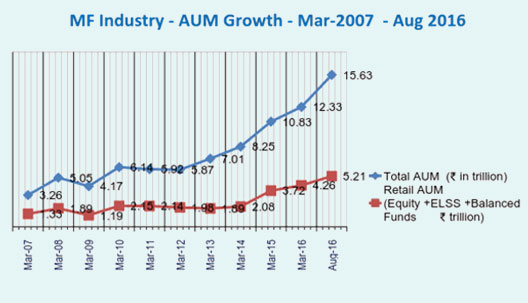
The Industry’s AUM crossed the milestone of ₹10 Trillion (₹10 Lakh Crore) for the first time as on 31st May 2014 and in a short span of two years the AUM size has crossed ₹15 lakh crore in July 2016.
The overall size of the Indian MF Industry has grown from ₹ 3.26 trillion as on 31st March 2007 to ₹ 15.63 trillion as on 31st August 2016, the highest AUM ever and a five-fold increase in a span of less than 10 years !!
In fact, the MF Industry has more doubled its AUM in the last 4 years from ₹ 5.87 trillion as on 31st March, 2012 to ₹ 12.33 trillion as on 31st March, 2016 and further grown to ₹ 15.63 trillion as on 31st August 2016.
The no. of investor folios has gone up from 3.95 crore folios as on 31-03-2014 to 4.98 crore as on 31-08-2016.
On an average 3.38 lakh new folios are added every month in the last 2 years since Jun 2014.

The growth in the size of the Industry has been possible due to the twin effects of the regulatory measures taken by SEBI in re-energising the MF Industry in September 2012 and the support from mutual fund distributors in expanding the retail base.

MF Distributors have been providing the much needed last mile connect with investors, particularly in smaller towns and this is not limited to just enabling investors to invest in appropriate schemes, but also in helping investors stay on course through bouts of market volatility and thus experience the benefit of investing in mutual funds.

In fact, even though FY 2015-16 was not a very good year for the Indian securities market, the MF Industry witnessed steady positive net inflows month after month, even when the FIIs were pulling out in a big way. This was largely because of the ‘hand-holding’ of the investors by the MF distributors and convincing them to stay invested and/or invest at lower NAVs when the market had fallen.

MF distributors have also had a major role in popularising Systematic Investment Plans (SIP) over the years. In April 2016, the no. of SIP accounts has crossed 1 crore mark and currently each month retail investors contribute around ₹3,500 crore via SIPs.

The graph indicates the growth of assets over the last 10 years.

WHAT ARE MUTUAL FUNDS?

A mutual fund is a pool of money managed by a professional Fund Manager.

It is a trust that collects money from a number of investors who share a common investment objective and invests the same in equities, bonds, money market instruments and/or other securities. And the income / gains generated from this collective investment is distributed proportionately amongst the investors after deducting applicable expenses and levies, by calculating a scheme’s “Net Asset Value” or NAV. Simply put, the money pooled in by a large number of investors is what makes up a Mutual Fund.

Here’s a simple way to understand the concept of a Mutual Fund Unit.
Let’s say that there is a box of 12 chocolates costing ₹40. Four friends decide to buy the same, but they have only ₹10 each and the shopkeeper only sells by the box. So the friends then decide to pool in ₹10 each and buy the box of 12 chocolates. Now based on their contribution, they each receive 3 chocolates or 3 units, if equated with Mutual Funds.
And how do you calculate the cost of one unit? Simply divide the total amount with the total number of chocolates: 40/12 = 3.33.
So if you were to multiply the number of units (3) with the cost per unit (3.33), you get the initial investment of ₹10.

This results in each friend being a unit holder in the box of chocolates that is collectively owned by all of them, with each person being a part owner of the box.

Next, let us understand what is “Net Asset Value” or NAV. Just like an equity share has a traded price, a mutual fund unit has Net Asset Value per Unit. The NAV is the combined market value of the shares, bonds and securities held by a fund on any particular day (as reduced by permitted expenses and charges). NAV per Unit represents the market value of all the Units in a mutual fund scheme on a given day, net of all expenses and liabilities plus income accrued, divided by the outstanding number of Units in the scheme.

Mutual funds are ideal for investors who either lack large sums for investment, or for those who neither have the inclination nor the time to research the market, yet want to grow their wealth. The money collected in mutual funds is invested by professional fund managers in line with the scheme’s stated objective. In return, the fund house charges a small fee which is deducted from the investment. The fees charged by mutual funds are regulated and are subject to certain limits specified by the Securities and Exchange Board of India (SEBI).

India has one of the highest savings rate globally. This penchant for wealth creation makes it necessary for Indian investors to look beyond the traditionally favoured bank FDs and gold towards mutual funds. However, lack of awareness has made mutual funds a less preferred investment avenue.

Mutual funds offer multiple product choices for investment across the financial spectrum. As investment goals vary – post-retirement expenses, money for children’s education or marriage, house purchase, etc. – the products required to achieve these goals vary too. The Indian mutual fund industry offers a plethora of schemes and caters to all types of investor needs.

Mutual funds offer an excellent avenue for retail investors to participate and benefit from the uptrends in capital markets. While investing in mutual funds can be beneficial, selecting the right fund can be challenging. Hence, investors should do proper due diligence of the fund and take into consideration the risk-return trade-off and time horizon or consult a professional investment adviser. Further, in order to reap maximum benefit from mutual fund investments, it is important for investors to diversify across different categories of funds such as equity, debt and gold.

While investors of all categories can invest in securities market on their own, a mutual fund is a better choice for the only reason that all benefits come in a package.
A PLETHORA OF SCHEMES TO CHOOSE FROM

Mutual funds are favoured globally for the variety of investment options they offer. There is something for every profile and preference.

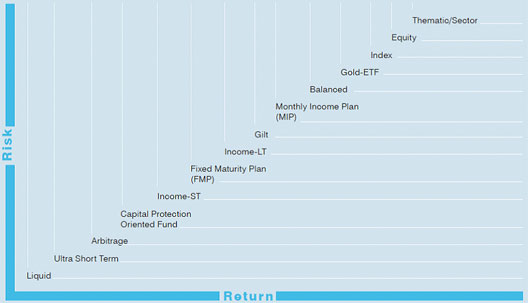
Chart 1: Risk/Return trade-off by mutual fund category


TYPE OF MUTUAL FUND SCHEMES

Mutual Fund schemes could be ‘open ended’ or close-ended’ and actively managed or passively managed.
OPEN-ENDED AND CLOSED-END FUNDS

An open-end fund is a mutual fund scheme that is available for subscription and redemption on every business throughout the year, (akin to a savings bank account, wherein one may deposit and withdraw money every day). An open ended scheme is perpetual and does not have any maturity date.

A closed-end fund is open for subscription only during the initial offer period and has a specified tenor and fixed maturity date (akin to a fixed term deposit). Units of Closed-end funds can be redeemed only on maturity (i.e., pre-mature redemption is not permitted). Hence, the Units of a closed-end fund are compulsorily listed on a stock exchange after the new fund offer, and are traded on the stock exchange just like other stocks, so that investors seeking to exit the scheme before maturity may sell their Units on the exchange.
ACTIVELY MANAGED AND PASSIVELY MANAGED FUNDS

An actively managed fund is a mutual fund scheme in which the fund manager “actively” manages the portfolio and continuously monitors the fund's portfolio , deciding on which stocks to buy/sell/hold and when, using his professional judgement, backed by analytical research. In an active fund, the fund manager’s aim is to generate maximum returns and out-perform the scheme’s bench mark.

A passively managed fund, by contrast, simply follows a market index, i.e., in a passive fund , the fund manager remains inactive or passive inasmuch as, she does not use her judgement or discretion to decide as to which stocks to buy/sell/hold , but simply replicates / tracks the scheme’s benchmark index in exactly the same proportion. Examples of Index funds are an Index Fund and all Exchange Traded Funds. In a passive fund, the fund manager’s task is to simply replicate the scheme’s benchmark index i.e., generate the same returns as the index, and not to out-perform the scheme’s bench mark.