Top Business News- News18.com

Monday, June 19, 2017

How to earn better returns from your MF portfolio


Pick up any mutual fund portfolio of an active investor and you will usually find it beset with typical problems. These can affect the overall performance. If we can understand, identify and rectify these common blunders, we can make much better returns out of our money.

A bloated Portfolio

Many people have the habit of collecting funds. Over time, therefore, you will find such portfolios having 40-50 funds. Diversification is good, but over-diversification is not.

Firstly, a large portfolio would mean that some funds in the portfolio will always be below-average, thus dragging down your total returns. Secondly, even with all the support of the computers and specialized websites, it is not possible to effectively manage a large portfolio. This again is going to impact the performance on the whole.

One should, therefore, have a limited but power-packed portfolio. The idea is to extract maximum punch with minimum cost and effort.

Chasing the Top Performers

There is too much focus on the performance and that too usually the recent one say over 3 months to 1 year. That�s why you always find this fascination among people for fund rankings.

Of course, performance matters! But making performance (and that too short-term) as the sole selection criteria can prove counter productive.

Historical evidence shows that no fund can always remain the top performer. It also shows that a fund, which has been consistently amongst the top quartile say over 3-5 years, will usually continue with its good performance. Similarly, a consistently poor performing fund usually finds it difficult to make it to the top.

Besides this the markets, as we all know, are highly sentiment-based. Therefore, more often than not, you will find some theme or the other being market fancy. It could be infrastructure, mid-caps or technology and so-on. At any given time you will find that most of the top performers belong to the same category.

So if you chase top performers you will end with similar schemes in your portfolio. In the process, the portfolio becomes concentrated, defeating the very idea of using MFs to diversify one's investment.

Your focus should not only be the past performance but also reputation & management of the AMC, funds investing style & focus, asset size, etc., besides of course, other key factors such as your investment horizon, risk appetite and other funds in your portfolio.

Mismatched and Unbalanced

It is but natural that the money you need in the short term should be in debt, while only the long term money should be in equity. Liquidity apart, your asset allocation between debt and equity should be in line with your risk appetite.

Some people of course do not do so. Some others start in planned manner. But, as equity and debt follow different paths, over time the portfolio will become mismatched and unbalanced.

As such you may either be over-exposed to equity thus increasing risk; or under-exposed thus losing out on the benefits of equity.

Or a liquidity mismatch may happen between the investment and your need. For example equity markets may be down when you need money, thus forcing you to sell at a loss.

Thus your portfolio needs timely review and correction in tune with your risk appetite & liquidity needs.

Infested with NFOs

Thousands of pages have been devoted to pointing out the myth of NAV. Yet the logic that NAV has absolutely no bearing on the future returns, simply does not register with a common investor.

Hence one can see thousands of crores flow into NFOs especially in a bull market, while the existing funds get practically nothing. In fact, it�s the opposite. People switch out of existing schemes to invest in NFOs under the false impression that Rs.10 NAV fund is cheaper.

As such a typical portfolio would be infested with NFOs. Higher costs in NFOs vis-a-vis existing funds will eat into the returns. Also as the so-called low NAV is why you invested in the NFO, it is quite likely that the funds style and focus does not fit with your needs. This also is going to hamper your returns.

Too Much Churning

Call it impatience or a false sense of being proactive or the instant-culture - we simply cannot wait and watch our portfolio grow. We always feel that we need to do something regularly.

Therefore, as soon as a fund shows good appreciation, we are quick to book profits. Or if a fund does not move for some time, we are equally prompt to dump it. This, for one, is adding to the costs in terms of capital gains taxes, entry loads, exit loads, STT, etc. But more importantly, we may be getting out too soon and thus missing out on future performance.

Selecting a mutual fund

What's strategy got to do with selecting a mutual fund? Shouldn't you just go and invest in the best performing fund? The answer is no. Mutual fund investing requires as much strategic input as any other investment option. But the advantage is that the strategy here is a natural extension of your asset allocation plan (use our Asset Allocator to understand what your optimum asset allocation plan should be, based on your personal risk profile). moneycontrol recommends the following process:

Identify funds whose investment objectives match your asset allocation needs
Just as you would buy a computer that fits your needs and budget, you should choose a mutual fund that meets your risk tolerance (need) and your risk capacity (budget) levels (i.e. has similar investment objectives as your own). Typical investment objectives of mutual funds include fixed income or equity, general equity or sector-focused, high risk or low risk, blue-chips or turnarounds, long-term or short-term liquidity focus. You can use moneycontrol’s Find-A-Fund query module to find funds whose investment objectives match yours.

Evaluate past performance, look for consistency

Although past performance is no guarantee for the future, it is a useful way of assessing how well or badly a fund has performed in comparison to its stated objectives and peer group. A good way to do this would be to identify the five best performing funds (within your selected investment objectives) over various periods, say 3 months, 6 months, one year, two years and three years. Shortlist funds that appear in the top 5 in each of these time horizons as they would have thus demonstrated their ability to be not only good but also, consistent performers. You can engage in such research through moneycontrol's Find-A-Fund query module.

Diversify

Don't just zero in on one mutual fund (to avoid the risk of being overly dependent on any one fund). Pick two, preferably three mutual funds that would match your investment objective in each asset allocation category and spread your investment. We recommend a 60:40 split if you have shortlisted 2 funds and a 50:30:20 split if you have shortlisted 3 funds for investment.

Consider Fund Costs

The cost of investing through a mutual fund is not insignificant and deserves due consideration, especially when it comes to fixed income funds. Management fees, annual expenses of the fund and sales loads can take away a significant portion of your returns. As a general rule, 1% towards management fees and 0.6% towards other annual expenses should be acceptable. Carefully examine load the fee a fund charges for getting in and out of the fund.

Why choose mutual funds?

Mutual funds are investment vehicles, and you can use them to invest in asset classes such as equities or fixed income. moneycontrolrecommends that you use the mutual fund investment route rather than invest yourself, unless you have the required temperament, aptitude and technical knowledge.

In this article we discuss why and how you should choose mutual funds. If you would like to familiarise yourself with the basic concepts and workings of a mutual fund, Understanding Mutual Funds would be a good place to start.

We are not all investment professionals

We go to a doctor when we need medical advice or a lawyer for legal guidance. Similarly, mutual funds are investment vehicles managed by professional fund managers. And unless you have a high Investment IQ, we recommend you use this option for investing. Mutual funds are like professional money managers, however a key factor in their favour is that they are more regulated and hence offer investors the ability to analyse and evaluate their track record.

Investing is becoming more complex

There was a time when things were quite simple - the market went up with the arrival of the first monsoon showers and every year around Diwali. Since India started integrating with the world (with the start of the liberalisation process), complex factors such as an increase in short-term US interest rates, the collapse of the Brazilian currency or default on its debt by the Russian government, have started having an impact on the Indian stock market.

Although it is possible for an individual investor to understand Indian companies (and investing) in such an environment, the process can become fairly time consuming. Mutual funds (whose fund managers are paid to understand these issues and whose asset management company invests in research) provide an option of investing without getting lost in the complexities.

Mutual funds provide risk diversification


Diversification of a portfolio is amongst the primary tenets of portfolio structuring (see The Need to Diversify). And a necessary one to reduce the level of risk assumed by the portfolio holder. Most of us are not necessarily well qualified to apply the theories of portfolio structuring to our holdings and hence would be better off leaving that to a professional. Mutual funds represent one such option

.Why credit opportunities funds make sense for young investors


Adhil Shetty- CEO -BankBazaar.com

If you are a seasoned investor, chances are that both debt and equity funds would be part of your investment portfolio. In a falling interest rate scenario, your returns from debt instruments will be on the lower side. But if you can invest in credit opportunity funds, you can still make decent returns. Here is a look at what credit opportunity funds are and why they may be good for young investors.

What are credit opportunity funds?


At their core, credit opportunity funds are debt mutual funds that invest in commercial papers and corporate bonds. Credit opportunity funds fundamentally invest in low-rated bonds that may see an upgrade in rating.

While success and failure of any market-driven fund depends on various parameters like overall economic health, interest rates, etc, the average return on credit opportunity funds has been the highest among all mutual fund categories till February 2016 averaging about at 8.70 per cent annually.

How credit opportunity funds are different from debt funds


Typically, a debt mutual fund scheme invests in bonds that have a high credit rating. Since credit rating is an indication of the company’s financial health and its ability to repay, most fund managers choose bonds based on credit ratings.

But credit opportunity funds invest in bonds that do not necessarily have the highest credit rating. Typically, a bond with AA credit rating is considered high risk compared to one with AAA rating. Credit opportunity fund managers may take a call on investing in the AA bond, preferring it over AAA ones. This may be because of a potential rating upgrade down the line or assured returns due to strong fundamentals.

When the economy improves, the improvement trickles down to the corporate sector. This sees improvement in its balance sheet and financials. With improving balance sheets, the rating agency upgrades the bonds issued by the company. A bond with high rating typically offers lower interest rate than a bond that comes with low rating. Hence a rating upgrade leads to a fall in yield and a rise in bond price. In a recovering economy there are more chances of rating upgrades and one can play this theme with credit opportunities fund.

Taxation aspects of credit opportunity funds


If you sell your investments in these funds within a year of investment, your gains are liable for income tax as per your tax slab, with capital gains being added to your individual income for the financial year.

If you redeem your fund after holding it for more than one year, you will be liable to pay tax at the rate of 20% after indexation on the capital gains.

Credit opportunity funds for young investors


If you are a young investor with an appetite for risk, you could consider diversifying your portfolio by investing in credit opportunity funds. Invest with a minimum two to three year time frame. This long term investment of more than two years allows the credit opportunity fund to offer better returns than most other investments including even bank fixed deposits. Also, being a debt investment instrument, your risks are far lower than investment in equity based funds. If you remain invested for more than three years, your post tax returns are much better than most fixed deposits.

When you design your financial portfolio, you have to carefully choose products that suit your needs. Opting for credit opportunity funds can be a good idea provided you have the resources to ride over intermittent volatility in bond markets and liquidity requirements you may have in the short term. (Courtecy : Money Control)

Are you investing in balanced funds for monthly dividends?

The trend of older or conservative investors moving their life savings into balanced funds essentially means that they are convinced these funds can give them regular dividends that can beat fixed deposits by a good margin over the medium to long term.
 ByDr.Renu Pothen
 As I write this column, it takes me back to the time when our parents were content that they were able to achieve all their goals by investing into one of the most simple investment opportunities: fixed deposits. Now, caught up in the buzz around rocketing markets and a growing economy, I find that many investors of their age are considering investing into equity focused funds so that they can lead a stress-free life in retirement. Our discussions with a few retired investors recently gave us the feeling that they seem to be pretty impressed with the monthly dividends being generated by balanced mutual funds, and are thinking of moving significant chunks of their portfolio from banks into these funds. While all of us in the mutual fund industry have been consciously working towards greater inclusion in the markets, to me, this trend is a little bit worrying as it goes against well-proven asset allocation strategies. Some of us might argue that funds with equity exposure allow these investors a better chance at beating inflation. But have they really considered the risks involved?

The trend of older or conservative investors moving their life savings into balanced funds essentially means that they are convinced these funds can give them regular dividends that can beat fixed deposits by a good margin over the medium to long term. This might be true in the current scenario, but is this going to be the reality five years from now as well? How well do these investors understand the potential volatility and is it fair to subject them to the vagaries of the stock market?

What is the balanced funds category all about? Can these funds provide a regular stream of income to investors - not just retirees, but even others who need regular payouts? My endeavour in this column is to take a quick look at the category, its management, and its record of providing growth and stability, while keeping volatility to the minimum when markets get into a jittery mood.

‘Balanced funds’ fall in the hybrid category and have more than 65 percent of the corpus invested into equities, while the rest is allocated among fixed income instruments. A trend that we are seeing now is that funds recently launched in this category are not entirely investing 65 percent or 70 percent of the portfolio in direct equities, but a small exposure is being used to find good opportunities in the arbitrage space.

LIC Mutual Fund Balanced Fund is the oldest fund in the category launched in 1991, followed by Canara Robeco Balance, UTI Children’s Career Balanced Plan and HDFC Prudence Fund (erstwhile Zurich India Prudence Fund). As of April end this year, there are 24 balanced funds in the industry with a total AUM of Rs 98,165 crore. It is interesting to note here that ~ 55 percent of this AUM is concentrated in four balanced funds: HDFC Prudence Fund, HDFC Balanced Fund, ICICI Prudential Balanced Fund and SBI Magnum Balanced Fund. The top 10 balanced funds have 88 percent of the surplus allocated among them. HDFC Prudence Fund is the largest fund in the category having a corpus of Rs 22,057 crore which translates into 22 percent of the market share as far as this category is concerned.

We normally recommend that our first time investors take an exposure into balanced funds so that they can get a feel of the two asset classes (equity and debt) without going through a roller coaster ride when the market decides to panic. However, at this juncture, we should also evaluate to what degree balanced funds really insulate investors from volatility. We have analysed the portfolios of all 24 balanced funds and have the following observations in this regard:

• Balanced funds have their equity allocation invested across the market capitalization spectrum. This means that the funds in this category take an exposure into the large/mid/small cap and even micro cap space. While the fund mandate given in the Scheme Information Document (SID) allows them to take this exposure, the mid to micro cap space is a fairly risky one, and it is important that conservative investors are aware of and understand the resulting risks.

• Coming to the fixed income allocation, active management on the basis of the interest rate outlook seems to be the norm for a few balanced funds. Taking a more aggressive stance, a few funds also scout for opportunities in the credit space (low rated papers, for example), exposing investors to both duration and credit risk.

These two observations alone should help investors make a more informed decision about whether funds in this category can give them the regular payouts they desire. Fund houses can pay out regular dividends only out of the distributable surplus available with them. Our markets have been partying since we got a reform-oriented government at the centre. This has given opportunities to fund management teams to create ‘alpha’ (a return in excess of that indicated by the benchmark index) in their portfolios by picking up gems in the mid/small/micro caps space. This in turn has allowed them to garner good distributable surplus in their funds, and thus pay out good dividends. To top it all, the duration calls in the fixed income space have also been supporting the returns on these funds. A deeper study of the top 10 balanced funds in our model, however, reveals that these funds have missed out on regular dividend payouts (even in the monthly option) during 2010-2015. Hence, investors’ dependence on balanced funds having the ability to pay out regular dividends may prove to be unfounded if Dalal Street decides to change track and move in a southward direction for some time.Conclusion

For new and conservative investors, exposure to balanced funds should be guided by a study of funds appropriate to their risk profile. A deeper study of the funds’ portfolios is warranted to make them aware of the potential risks and vulnerabilities. For risk-averse investors, parking their hard-earned money into funds whose surplus is allocated among the most volatile segment of the equity market, while also taking risky bets in the debt instruments, is something that can definitely be avoided. It would, in fact, be ideal if portfolios of balanced funds are created in such a manner that they are suitable to meet risk averse investors’ needs.
(The writer is Research Head at Fundsupermart.com, India) (Courtecy: Money Control)

Ramayana shows how to make money in stocks: Nilesh Shah Read

ETMarkets.com| Jun 19, 2017
The stock market is like a boxing ring, says Nilesh Shah, MD of Kotak Mutual Fund. If you enter the ring with the hope that you will not get hurt, then you are never going to win the match, because you will be running away from your opponent and finally the referee will say ‘hell with it’.
“So if you are entering the stock market but not willing to take a downside, then please do not enter the market. It is not a place meant for you. First, have the maturity to take a loss, then you can make money,” Shah said in an interview with ETNow.
We picked some wisdom and investing tips from the interview verbatim.

Thumb rule for entering the stock market
You should read the Ramayana, because it is written how to make money. I am sure, all of you have the Ramayana, but you should not read it like the Gujju bhai. In Ramayana, which was the richer city, Lanka or Ayodhya? It was Lanka; it was gold-plated. How did Lankans become so rich? Because they invested like Kumbhkaran; they invested in the equity market and slept for 14 years. That is why they became rich. There, Ramayana has given you a solution.

Stocks that have fallen 99%
True, Lanka jal gaya tha, but when? When you went and picked that stocks that were leveraged, when you went into bed with a bad promoter, When you went and picked that stocks that were leveraged, when you went into bed with a bad promoter, when ..

So, should you always buy bad news?
In life, you always get an opportunity to score. Let’s take the example of a cricket match. Did Sachin Tendulkar become Sachin Tendulkar because he got all the half-volleys to hit for a fours and sixes? Of course, not. He got opponents who were throwing bouncers at him to kill him; they would have loved to injure him, but Tendulkar survived those bouncers and that is why he came Tendulkar. So if you think in the pitch of life or stock market you are only going to get half-volleys and you will hit them for fours and sixes, that is never going to happen. You are going to get bouncers. Which is why I said, if you cannot be Eklavya, you should stay with mutual funds.

Watch the Sensex daily or do SIP and sit?
Today the mutual fund industry has reached a level where all of us have worked together to create a long-term investment culture. I will give you an example. I went to RPG House office and there was a watchman who was looking at me and I could sense that he was looking at me. But I ignored him to move forward, meet the CFO and came down and then this guy said you the person who is coming on television. Now when a watchman says he has started an SIP, then I have done something in life.

Wealth creation
Go and attend any good company’s AGM, and you will rarely find a person coming and congratulating the company top brass for the stock performance. The amount of wealth created by the good companies in India over the past 25 years is mind boggling. I will show you the example of InfosysBSE -1.17 % versus MastekBSE 1.09 %, 425000% return, it is not a small number. So long-term wealth is created by long-term investment and we are lucky to be born in this era. In my career, I have seen India grow 10 times from $200 billion to $2 trillion. I do not think there will be generations like mine who will see 10-times growth in a country.

Importance of regular investment
First is the acceptance of the fact that you do not know where the market will go. So, the moment you realise that, you get the benefit of regular investment. All of us do regular investment for our physical health, we take breakfast, we take lunch, we take dinner. I have not seen a person who eats for seven days at one go and then uses his time for the next seven days for productive activity. So what you do for physical health, you have to do for financial health; you have to have your breakfast investment, lunch investment, dinner investment. Now do not confuse that with day trading, I am talking about monthly SIPs

Importance of asset allocation
So asset allocation is basically the skill of creating a balanced diet. And you know if you see our culture, our home food, home thaali has a balanced diet. It has daal, roti, chawal subzi and some people like desserts and some people make dessert main food like gujju bhais but that is what we do physical health, a right mix of protein, carbohydrates and other things put together it gives you taste as well as health.

The same applies to the asset allocation in investment. You need some equity which will create growth; you need some fixed income which creates stability; you need some gold which gives you hedge against something going wrong in the country and giving global currency return; you need some real estate because that is also an asset class, which can give you stable return. So create an ideal balance of real estate, gold and other commodities, fixed income and equities and that will ensure that you are consistently making money, you can ride the volatility of the market and that creates wealth.


Friday, June 16, 2017

6 Factors to Keep In Mind When Choosing SIPs for Investing Money


Mutual Funds article in Advisorkhoj - 6 Factors to Keep In Mind When Choosing SIPs for Investing Money
Systematic Investment Plans (SIPs) are one of the most perplexing investment instruments. While most new investors are wary of them, a lot of seasoned investors too have struggled to get their SIP strategy right. So, before jumping on to understanding how to choose the best SIP, let’s first get some clarity on what SIP really means.

Decoding SIP

A systematic investment plan enables you to invest a fixed amount at regular intervals (monthly, quarterly or annually) in mutual funds, which in turn invest in the markets. Being a flexible instrument, SIPs help you build wealth and instil the habit of saving even in the most undisciplined of us. The major benefit of investing in SIPs is the power of compounding. You earn compound interest on your deposits on a monthly basis, thereby, increasing your investment amount significantly over the long run.

Choosing the Best SIP

Choosing the right fund to invest in via a SIP is very critical to earning high returns. Keep in mind the following factors when deciding which SIP to invest in.
  1. Investment Objective:

    Before you even start investing in a fund, it is important to know what you are investing for. You need to ask yourself two questions. 1) Are you investing for the short term or the long term? And, 2) what is your risk appetite? Your investment horizon and risk profile will help determine which type of fund will suit you. For instance if you are a risk-averse investor and want consistent returns, without a tear-jerk reaction, debt funds might be more your thing. However, if you are in for the long haul and are comfortable with market volatility, equity funds should be your investment avenue.
  2. Fund type:

    As mutual funds are of various types, it’s important to know which type is suitable for your risk appetite. Let’s take a quick look at the types of mutual funds:
    1. Asset-based mutual funds

      1. Equity Funds – These funds are further categorised into various types: large cap, diversified, mid & small cap, sector and index funds.

      2. Debt Funds – These funds can be further classified based on investment tenure: money market, income and fixed maturity funds.

      3. Balanced Funds – These funds are a blend of equity and debt funds and present the best of both worlds to an investor. They counter equity fund’s risky profile by simultaneously investing in debt instruments to ensure steady returns to the investor.
    2. Structure-based mutual funds

      1. Open-ended – An investor can enter or exit these funds at any time, without restriction.

      2. Close-ended – These funds are open for investment for a specific time during the scheme’s launch. Once the new fund offer (NFO) closes, no further investments can be made.

  3. Historical Performance & Returns: Carefully study funds before investing in them. Compare funds on the basis of performance over a 3 to 5 year term. A comparison of historical performance will tell you how strong or weak a fund is and whether it can withstand market volatility. Avoid funds that perform strongly when the market is high but collapses as soon as the market also falls. When studying these trends, avoid a myopic view and look at fund’s performance over the long term, say 5 years and 10 years.
  4. Fund House:A fund is as good as its fund house. The decisions taken by the fund house shape a fund’s return-yielding capacity and growth. If the fund house does not take the right calls, we investors will end up losing our money. Before investing, read about the fund house and the fund scheme you intend to invest in. Get a copy of the scheme information document and key information document to get such details as the fund house’s investment approach, number of schemes offered, funds/products designed with investors in mind, and more. Answers to these questions will empower you to decide which fund house will be able to help you reach your investment goals.
  5. Expense ratio:If your research has boiled down to funds that are similar in nature, you can choose among them on the basis of expense ratio. This ratio comprises management fee and administrative costs, and is essentially a fund’s annual fee. Schemes that have higher assets under management usually have lower expense ratios, making them a go-to option. A difference of 0.5% in expense ratios of two funds may seem negligible but should not be taken lightly. Consider Fund A with an expense ratio of 1.5% and Fund B with 1%. Now, for these two funds to give same returns, Fund A will have to outperform Fund B every single year. While this may seem doable, in the long term, maintaining this performance will be difficult. Simply put, a high expense ratio will pull down a fund’s performance.
  6. Entry or exit load: Earlier, investing in funds invite a small fee in the form of entry load. However, Securities and Exchange Board of India (SEBI) has stopped funds from levying an entry load. So, now, the only time you pay is when you are leaving a fund (also known as redeeming a fund) which is called an exit load, before the exit load period. The fee varies with scheme, investment tenure and amount. For example, if you redeem your fund whose value has grown to Rs 100 at an exit load of 2%, you will only get Rs 98. Exit loads too are regulated by SEBI and all the fund houses have to follow the directives.

Mutual Fund Investments are subject to market risk, read all scheme related documents carefully.

How Mutual Fund SIPs created wealth in the last 15 years: Diversified Equity Funds

Mutual Funds article in Advisorkhoj - How Mutual Fund SIPs created wealth in the last 15 years: Diversified Equity Funds
Mutual Fund Systematic Investment Plans or SIPs were introduced in India way back in 1993 by Franklin Templeton Mutual Fund. Since then investing through SIPs have come a long way according to data provided by Association of Mutual Funds in India (AMFI). The current SIP book is around 1.32 Lakhs Crores and the industry is adding around Rs 5,000 Crores per month through SIPs. That means, in another two years we can expect the mutual fund industry SIP book to be doubled.
The data further shows that mutual fund industry added on an average 6.36 Lakh SIP accounts every month during the FY 2016-17. Also, during the same period Rs 43,921 Crores were collected through SIPs.

If you crunch long term industry data of equity mutual fund returns, there is no doubt Mutual Fund SIPs have created immense wealth for the investors who remained invested for the long term. There are a number of advantages of investing through SIPs which we will explore here –

Wide choice of funds

– Mutual funds SIPs offer a wide array of schemes belonging to various categories of funds. You can start a SIP in a fund suiting your risk profile, investment horizon and fund objectives.

No need to time the market

– It is impossible to time the markets as you do not know how it will behave. By investing a fixed amount on a fixed date every month, you are investing at high and low points of the market and thus benefiting from rupee cost averaging.

Flexible investments

– Mutual Fund SIPs are very flexible. There are no restrictions and penalties on regular SIP payments and withdrawals. You can start a SIP with a monthly investment of as low as Rs 500 anytime. Similarly, you can stop the SIPs anytime you wish, in case you do want to continue.
Disciplined approach

– SIPs bring disciplined approach to investing. By investing a fixed amount every month from your investible surpluses you can build a big corpus for the future. Investing in SIPs is habit forming and helps you invest the money which otherwise you would often spent on things that are not required.
Tax efficient

– Investing in equity mutual funds, either through SIP or lump sum is most tax efficient. Long term (investments held for more than one year) capital gains are tax free. Dividends received from equity mutual funds are also tax free. Moreover, SIPs in ELSS Mutual Funds helps you save taxes under Section 80C of The Income Tax Act 1961 (maximum Rs 150,000 per annum).

In this article, we will look at how SIPs in diversified equity funds have created long term wealth for the investors in the last 15 years. In case you want to know why invest in diversified equity funds, we suggest you read this article - Investing in diversified equity funds is a safer option.

For this article, we have selected 10 diversified equity funds that have given the best returns in the 15 years. You can see the full list here. Having selected the above funds, however, we are neither recommending these funds to start new SIPs nor trying to prove a point that these are the best funds. This is just to illustrate you how long term investments in SIPs, have created wealth for the investors and if you have not yet started a SIP for yourself then this is high time you should start one!

Here is the list of top diversified equity funds which have given the most returns in the last 15 years if one had invested in them through SIPs -
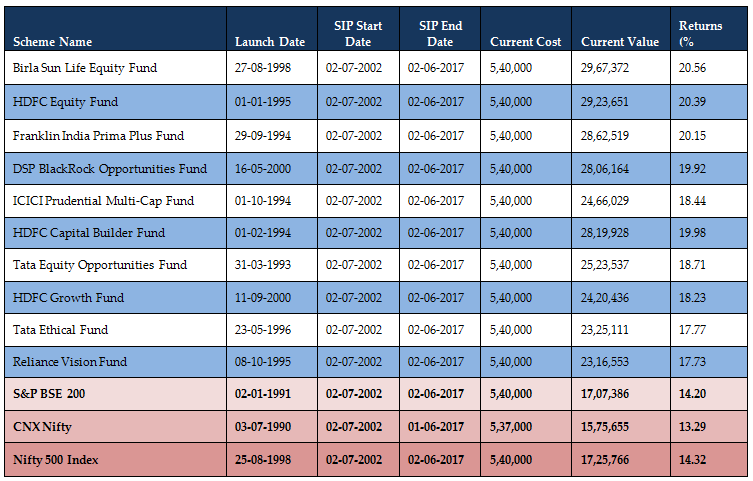


Each of the funds in our selection (Regular plan – Growth option) has given SIP returns ranging from 17.50 – 20.50%. Since SIP investments are made over a period of time, the method of calculating SIP returns is different from that of Lump Sum investments. SIP returns are calculated by a methodology called XIRR, which is a variant of Internal Rate of Return (IRR). XIRR is similar to IRR, except that XIRR can calculate returns on investments that are not necessarily strictly periodic.

For our examples, we have assumed a monthly SIP of Rs 3000 only, made on 2nd of every month in the funds that we have selected above (based on the returns generated by them). The SIP start date was 15 years back in July 2002. Over this period, the investor would have invested Rs 5.40 lakhs through monthly instalment of Rs 3,000.
As you can see above, the investors would have accumulated Rs 23.16 Lakhs to Rs 29.67 Lakhs against an investment of Rs 5.40 Lakhs only in the last 15 years. These top 10 SIP funds have beaten their respective benchmarks and CNX NIFTY Index with a huge margin. The same amount, i.e. Rs 3,000, if invested in CNX NIFTY would have given you only Rs 15.75 Lakhs against Rs 23.16 Lakhs generated by the 10th fund in the above list! SIPs in these top 10 funds would have given you annualized 3 to 7% more returns than CNX NIFTY, NIFTY 500 Index and S&P BSE 200.

Let us now discuss 5 Funds selected by us in more details –

Birla Sun Life Equity Fund:

This is one the top performing funds in the current charts also. Launched in 1998, the fund has an AUM of Rs 5,287 Crores and has given 24.92% annualised returns since launch. The fund is managed by Anil Shah who has chosen financial, Metals, Energy, FMCG and Healthcare as top 5 sectors to invest for this fund.
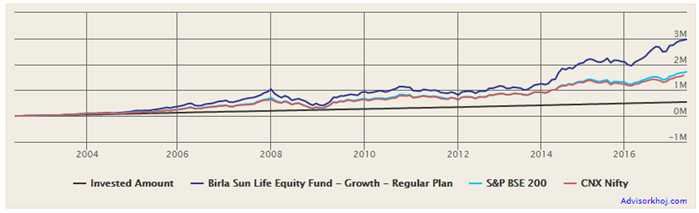


If you had started a monthly SIP of Rs 3000 in Birla Sun Life Equity Fund way back in July 2002, by now you would have accumulated nearly Rs 29.67 lakhs corpus, with an investment of only Rs 5.40 lakhs. Over the 15 year period the compounded annual returns on your SIP investments in this fund would be over 20%.
ICICI Prudential Multi-Cap Fund:

This is one of thepopular funds from ICICI Prudential Mutual fund stable. Launched in 1994, the fund has an AUM of Rs 2,668 Crores and has given over 15% annualised returns in the last 22 years. The fund is managed by George Heber Joseph and Atul Patel who have chosen financial, construction, Services, Technology and Healthcare as top 5 sectors to invest for this fund.
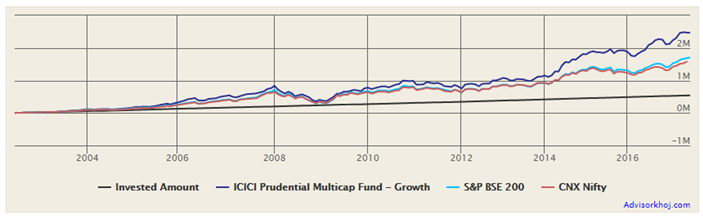


If you had started a monthly SIP of Rs 3000 in ICICI Prudential Multi-Cap Fund way back in July 2002, by now you would have accumulated nearly Rs 24.66 lakhs corpus, with an investment of only Rs 5.40 lakhs. Over the 15 year period the compounded annual returns on your SIP investments in this fund would be over 18%.

DSP BlackRock Opportunities Fund:

This is one of theTop performing funds from DSP BlackRock Mutual fund stable. Launched in May 2000, the fund has just completed 17 years and has an AUM of Rs 2,344 Crores and has given over 19% annualised returns in the last 17years. The fund is managed by renowned fund manager, Rohit Singhania who has chosen financial, Energy, construction, FMCG and Metals as top 5 sectors to invest for this fund.
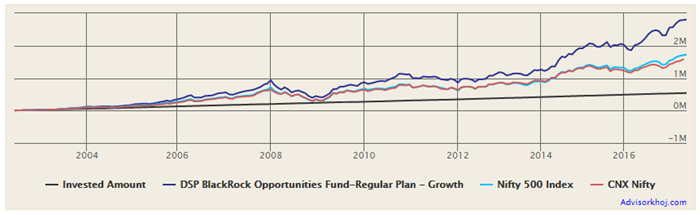


If you had started a monthly SIP of Rs 3000 in DSP BlackRock Opportunities Fund way back in July 2002, by now you would have accumulated nearly Rs 28.06 lakhs corpus, with an investment of only Rs 5.40 lakhs. Over the 15 year period the compounded annual returns on your SIP investments in this fund would be close to close to 20%.

HDFC Capital Builder Fund:

This is one of the popular funds from HDFC Mutual Fund stable.Launched in Feb 1994, the fund has just completed 23 years and has an AUM of Rs 1,566 Crores and has given around 15% annualised returns since inception. The fund is managed by Miten Lathia, who has chosen financial, Energy, construction, Technology and Healthcare as top 5 sectors to invest for this fund.
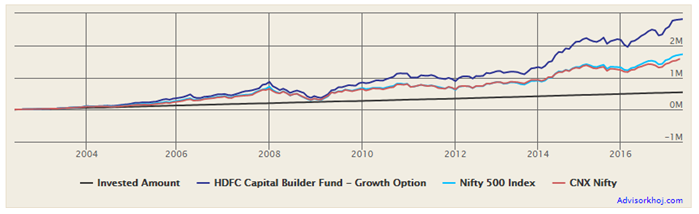


If you had started a monthly SIP of Rs 3000 in HDFC Capital Builder Fund way back in July 2002, by now you would have accumulated nearly Rs 28.19 lakhs corpus, with an investment of only Rs 5.40 lakhs. Over the 15 year period the compounded annual returns on your SIP investments in this fund would be close to close to 20%.

Franklin India Prima Plus:

This is one of thetop rated and marquee funds in the diversified equity fund category. Launched by Franklin Templeton Mutual Fund way back in 1994, the fund has a long history of consistent performance and has a big AUM of Rs 10,964 Crores. The fund has given over 19% annualised returns since inception. The fund is managed jointly by veteran fund managers, Anand Radhakrishnan and R Janakiraman. The top 5 sectors that the fund has invested in are financial, automobile, construction, Technology, GMCG and Healthcare.
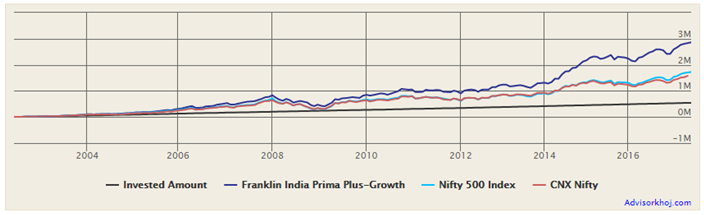


If you had started a monthly SIP of Rs 3000 in Franklin India Prima Plus way back in July 2002, by now you would have accumulated nearly Rs 28.63 lakhs corpus, with an investment of only Rs 5.40 lakhs. Over the 15 year period the compounded annual returns on your SIP investments in this fund would be over 20%.
Rolling returns of the 5 diversified equity Funds

So far we have seen how Diversified equity funds have created wealth for investors in the last 15 years. We have also seen how the 5 funds, from 5 different fund houses, analysed by us were true wealth creators. Let us now see how these 5 funds are doing now?
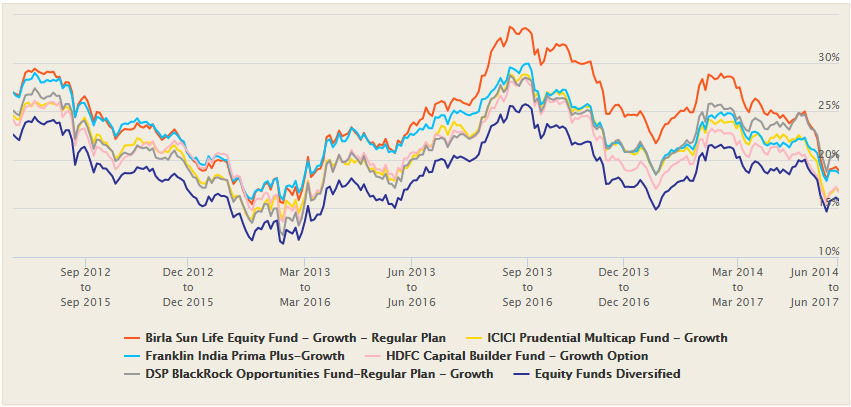


As you can see in the above rolling return chart, all the 5 funds in our selection continue to beat their benchmark returns (the deep blue line) in the last 5 years. We have taken 3 years period for the rolling return as we feel that one should have a minimum 3 years investment horizon if investing in equity mutual funds. Therefore, we can conclude that if you have SIPs in these funds, you should continue with your investments in the long run while reviewing the individual performances at least every 1 or 2 years.

Conclusion

In this article, we have seen how Systematic Investment Plans or SIPs in diversified equity funds have created wealth for the investors who stayed invested in the long termSIPs. SIPs benefit from the power of compounding, and therefore the earlier we start our SIPs and longer we stay invested, the greater is the potential for wealth creation. However, it is important to select good funds for your SIPs. You should consult your financial adviser who can help you select good funds that is suitable according to your risk profile.
You may also refer to Top Consistent Mutual Fund Performers section in our research section of the website wherein we have picked the consistent funds from various categories.

Mutual Fund Investments are subject to market risk, read all scheme related documents carefully.